

Getting ordered into treatment can feel confusing, especially when the court paperwork uses terms like probation, diversion, treatment conditions, testing, or completion. The biggest mistake is assuming that simply enrolling in a rehab program means you have satisfied the court’s order.
Court ordered rehab is a legal requirement tied to the specific terms of your case. What you must complete can depend on the statute involved, the court’s order, your probation conditions, and the program approved for your case.
California has several different treatment-related pathways. For example, Penal Code §1000 provides a pretrial diversion framework for certain eligible drug offenses, while Proposition 36 created a separate treatment-mandated felony process that uses deferred entry of judgment. In qualifying Proposition 36 cases, eligible defendants may choose treatment instead of custody, with successful completion potentially allowing the charges to be dismissed.
That means there is no universal California checklist that applies to everyone.
Before enrolling, make sure you understand exactly what your court order requires and whether the program you choose can satisfy those requirements.
What Compliance Means: The Four Things Courts Check

Although individual orders vary, treatment compliance commonly comes down to four broad questions:
- Did you enroll in the required treatment?
- Did you participate for the required duration?
- Did you follow the program and court conditions?
- Can completion be documented?
The fourth point is easy to underestimate.
Telling your probation officer that you attended rehab is different from having documentation showing that you completed the treatment required by your order.
Your court paperwork may specify the treatment type, duration, testing requirements, reporting obligations, or other conditions. Some cases may require a particular program or level of care rather than simply “go to rehab.”
The appropriate ASAM level of care can also matter clinically. California’s Department of Health Care Services (DHCS) uses ASAM-based levels of care within its substance use disorder treatment system, ranging from outpatient services through more intensive levels of treatment.
For example, outpatient treatment and residential treatment are not interchangeable simply because both involve addiction treatment.
Your attorney, probation officer, or court-approved treatment coordinator can help clarify what your specific order requires.
Compliance Is More Than Showing Up
Attendance is important, but compliance may involve more than attendance.
Depending on the order, you may need to:
- Attend scheduled treatment sessions
- Complete an assessment
- Participate in individual or group counseling
- Submit to drug or alcohol testing
- Follow program rules
- Maintain contact with probation
- Complete required educational components
- Remain in treatment for a specified period
- Provide documentation of participation or completion
If your order says something specific, follow the order rather than relying on what someone else completed in a different case.
Which Programs May Satisfy the Order — and Which May Not
One of the most important questions to ask before enrolling is:
“Will this program satisfy my court order?”
A treatment center can provide legitimate addiction treatment and still not be the right program for your particular legal requirement.
California DHCS licenses or certifies different types of substance use disorder programs, and ASAM criteria are used in several parts of California’s treatment system to determine or designate appropriate levels of care.
But that does not mean every DHCS-certified program automatically satisfies every court order.
The court may have specified:
- A particular type of treatment
- A minimum treatment duration
- A specific level of care
- Drug or alcohol testing
- Individual counseling
- Group sessions
- Probation reporting
- A court-approved provider
- A particular diversion or treatment program
What About Drug Court?
Drug court is generally a specialized court program designed around treatment, supervision, testing, and other conditions rather than simply sending someone to a standard rehabilitation program.
The exact structure varies by county and program.
If your case is part of a drug court program, do not assume that enrolling independently in another treatment center satisfies your drug court obligations. Your program may have specific providers, testing procedures, court appearances, and reporting requirements.
The same principle applies to DUI rehab.
A person ordered to complete treatment following a DUI should not assume that any addiction program will automatically satisfy the court’s requirements. DUI-related requirements can include education, assessment, treatment, reporting, and other conditions depending on the case.
Ask Before You Enroll
Before paying for treatment, ask:
“Can you confirm in writing that your program meets the treatment requirements in my court order?”
Then provide the program with the actual court paperwork.
Do not rely on a website saying “court approved” unless you understand what that statement means and whether it applies to your particular case.
If you have received a court order and are unsure what type of treatment may satisfy it, the safest first step is to review the order with your attorney or probation officer before enrolling. A treatment provider can then help determine whether its program fits the clinical and practical requirements.
Who Reports to Whom, and the Completion Certificate
Another common source of confusion is reporting.
A treatment provider may maintain attendance and treatment records, while probation may monitor compliance with probation conditions. The court ultimately operates according to its own orders and procedures.
For example, LA County Probation supervises court-ordered conditions and may connect people under supervision with required treatment services. If your case is supervised by LA County Probation, confirm exactly what documentation your officer expects and who is responsible for submitting it.
There is no universal rule that every rehab automatically sends everything directly to the judge.
The exact reporting process depends on the court program and the conditions of your case.
That is why you should ask:
- Who receives my attendance reports?
- Does the provider report directly to probation?
- Do I need to provide documentation myself?
- How often are reports submitted?
- What happens if the provider cannot verify attendance?
- What document proves successful completion?
The Certificate of Completion
A certificate of completion is typically documentation showing that you completed a specified treatment program or requirement.
It may include information such as:
- Your name
- Program name
- Treatment dates
- Type of program
- Completion date
- Provider information
- Authorized signature or verification
But a certificate does not automatically guarantee that the court will consider every legal obligation satisfied.
The court may require additional documentation, testing records, probation reports, or other conditions.
Keep copies of everything.
Save:
- Intake paperwork
- Treatment plans
- Attendance records
- Testing results when provided to you
- Completion certificates
- Discharge paperwork
- Emails or letters from the program
- Communications with probation
- Court orders and amendments
Do not assume the treatment provider will retain every document forever or that another agency will automatically have the same records.
Testing, Missed Sessions, Excused Absences
Testing can be a major part of court-supervised treatment.
Depending on the case, you may be required to submit to drug or alcohol testing as a condition of probation, diversion, or treatment.
A missed test can sometimes create a problem even when you did not actually use a substance.
The same is true of missed treatment sessions.
If you are sick, have a transportation problem, have a family emergency, or have another legitimate reason for missing treatment, communicate as soon as possible.
Do not simply disappear.
Ask the program what its policy is for excused absences and obtain documentation when appropriate.
For example, if you miss a session because you were hospitalized, documentation may help establish why you were absent. Whether an absence is ultimately considered excused is determined by the applicable program or court requirements.
What Counts as a Violation?
A violation can involve different things depending on the order.
Potential issues can include:
- Failing to attend required treatment
- Leaving treatment without authorization
- Failing required drug or alcohol testing
- Violating probation conditions
- Failing to maintain contact with probation
- Failing to complete treatment within the required period
- Failing to follow specific court-ordered conditions
But one missed appointment does not necessarily produce the same legal consequence in every case.
The response can depend on the type of proceeding, the terms of the order, prior compliance, the reason for the missed requirement, and what the court or probation department decides to do.
If something goes wrong, document it and communicate promptly rather than hoping the problem disappears.
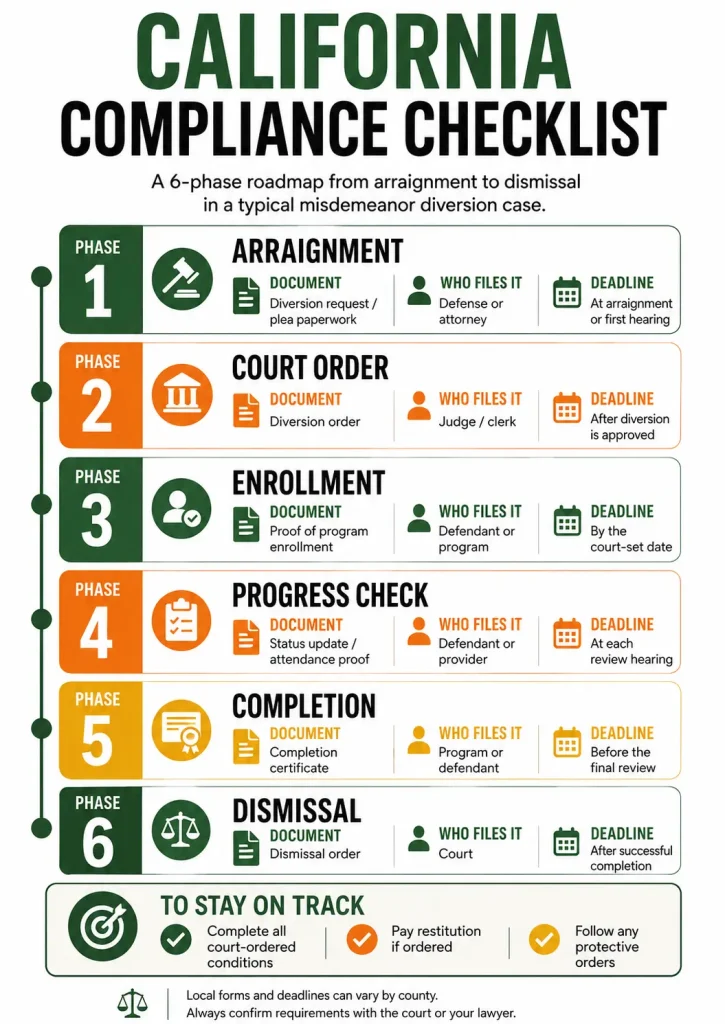
Diversion: How Compliance Can End the Case
Treatment can be particularly important when it is part of a diversion or deferred-entry-of-judgment program, but those terms do not describe one single California process.
Under certain California diversion structures, successful completion can have significant consequences for the underlying case.
For certain eligible drug offenses, Penal Code §1000 provides a pretrial diversion framework. Successful completion of the applicable diversion requirements can allow the case to be dismissed under the statute, depending on the facts and the court’s findings.
Proposition 36 also created a separate treatment-mandated felony pathway that took effect December 18, 2024. For eligible defendants, the process can involve deferred entry of judgment, treatment instead of custody, and potential dismissal after successful completion of the required treatment and court conditions.
That is different from simply being ordered to attend ordinary probation treatment.
Deferred Entry of Judgment Is Not One Universal Program
The phrase deferred entry of judgment can appear in different California legal contexts, so you should identify the specific statute and program involved in your case. Penal Code §1000 is a pretrial diversion framework, while Proposition 36 treatment-mandated felony cases use a separate deferred-entry-of-judgment process.
For adult criminal cases involving eligible drug offenses, Penal Code §1000 is one important pretrial diversion framework.
Other diversion programs can have different eligibility rules, treatment requirements, deadlines, and consequences.
Mental health diversion is another distinct legal pathway. It should not be treated as interchangeable with substance use treatment or a standard rehabilitation order.
If your attorney tells you that diversion is available, ask exactly which statute and program applies.
The details can determine what you must complete and what happens after successful compliance.
If You Slip: Tell Your Attorney First
A relapse, missed session, positive test, or discharge from treatment can feel like the end of your case.
It does not necessarily mean that.
But ignoring it can make the situation harder.
If you have a positive test or miss treatment, contact your attorney as soon as possible and explain what happened.
Your attorney can help determine:
- Whether a violation has actually occurred
- What notice has been given to probation
- Whether you can return to treatment
- Whether additional treatment may help
- Whether you need a court hearing
- What explanation or documentation may be relevant
Do not attempt to create an explanation that is not true.
If you made a mistake, be honest with your attorney so they can evaluate the situation accurately.
What If You Have Not Entered Treatment Yet?
If you are still trying to figure out how to get someone into rehab because a court order applies to a family member or friend, remember that legal authority and personal willingness are different issues.
A court can impose treatment requirements on a defendant, but a family member generally cannot simply force another competent adult into voluntary treatment because they believe rehab would help.
If you are trying to help someone comply with an existing court order, start with the actual paperwork.
Find out:
- What treatment was ordered?