
If you’re a veteran trying to stop drinking or using drugs, one of the first questions may be simple: Can the VA actually get me into treatment? Understanding how VA substance abuse treatment works can make the process easier to navigate.
For eligible veterans, the VA provides substance use treatment ranging from outpatient counseling and medication treatment to medically managed detoxification and residential rehabilitation. Getting from “I need help” to an actual treatment bed can still involve several steps, and the process may look different depending on your eligibility, clinical needs, location, available programs, and whether the VA can provide the appropriate level of care directly.
For veterans who have been dealing with alcohol or drug use alongside trauma, depression, or other mental health concerns, the process can also involve treatment for both conditions rather than treating substance use in isolation.
Here is what to expect.
How a Veteran Actually Gets a VA Rehab Bed

VA treatment generally starts with an assessment rather than immediately placing someone into residential rehab.
If you are already receiving VA health care, you can start by telling your primary care provider that you need help with alcohol or drug use. Your provider can screen you and connect you with substance use services. You can also contact a VA medical center or a local Substance Use Disorder (SUD) program directly. VA maintains a directory of SUD programs, and even VA medical centers without a dedicated SUD program can provide treatment through their mental health services.
The first appointment may involve questions about:
- How often you drink or use drugs
- How much you use
- Withdrawal symptoms
- Previous treatment attempts
- Overdose history
- Mental health symptoms
- PTSD or trauma symptoms
- Medications you currently take
- Your housing and support situation
- Your ability to remain safe outside a structured setting
Alcohol screening may include the AUDIT-C, a brief screening tool used to identify potentially unhealthy alcohol use.
The important point is that asking for help does not automatically mean you will be sent to a residential program. The clinical team assesses what level of care is appropriate based on your substance use, withdrawal risk, mental health, medical needs, safety, and recovery environment. Depending on the program, this may be described using ASAM level of care concepts.
That could mean outpatient treatment, intensive outpatient care, medically managed withdrawal, residential rehabilitation, or another level of support.
VA residential rehabilitation can provide a structured, live-in environment for veterans with substance use disorders and related mental health needs.
What can slow the process down?
Sometimes the obstacle is not whether treatment exists. It is getting through the administrative and referral process.
If you are waiting for an assessment, referral, authorization, or bed, ask specifically:
“What is the next step before I can be admitted, and who is responsible for completing it?”
That question can help identify where your referral is actually sitting.
If you need a level of treatment that cannot be provided promptly through your local VA, ask whether community care is an option.
Eligibility Without a Service Connection
You do not necessarily need a service-connected disability to receive VA health care.
VA eligibility is based on several factors, including military service and discharge requirements. Veterans who qualify for VA health care are assigned to one of eight VHA priority groups, which can affect eligibility and costs. Service-connected disabilities are one factor, but they are not the only path into VA health care.
For example, VA’s priority groups include veterans with certain service-connected disabilities, former prisoners of war, veterans receiving VA pension benefits, and veterans who qualify based on income or other eligibility criteria.
If you are not enrolled, the starting point is generally VA Form 10-10EZ, the application for VA health benefits. VA says veterans need to be enrolled in VA health care to receive care at VA facilities or have VA cover eligible care through a community provider.
You can apply online or complete the form with information such as your military service history, discharge documentation, insurance information, and household income.
There is another resource worth knowing about: the Vet Center.
Vet Centers can provide substance use assessment, counseling support, and referrals for eligible veterans. They can be particularly useful for veterans who are hesitant to begin the process through a traditional VA medical center.
If you are unsure whether you qualify, do not assume you are ineligible simply because your substance use is not service-connected.
Ask the VA to determine your eligibility.
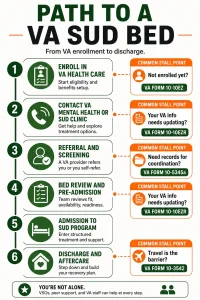
Screening to Detox to Residential SUD
Once you enter the VA system, treatment generally progresses according to your clinical needs rather than a one-size-fits-all timeline.
1. Screening and assessment
The initial assessment helps determine whether you have a substance use disorder, how severe it may be, and what other problems need attention.
For someone drinking heavily, for example, the team may be concerned about withdrawal risk. For someone using opioids, the assessment may include overdose history, withdrawal symptoms, cravings, and previous medication treatment.
2. Withdrawal management
If stopping alcohol or certain drugs suddenly could be medically dangerous, detoxification may be recommended.
VA offers medically managed detoxification and medications for substance use disorders. For opioid use disorder, treatment may include medications such as buprenorphine or methadone.
Naltrexone may also be considered for appropriate patients, depending on the substance involved, medical history, current medications, and treatment goals.
Detox is not the same thing as rehabilitation. Getting through withdrawal is only the beginning of recovery.
3. Determining the appropriate level of care
After assessment or detox, the treatment team determines what level of care makes sense.
Some veterans can participate in outpatient treatment while continuing to live at home. Others may need a more structured environment because of relapse risk, unstable housing, severe substance use, medical concerns, or co-occurring mental health conditions.
Residential treatment may provide a temporary environment where the veteran can focus on recovery without the same access to alcohol or drugs and daily pressures that contributed to continued use.
The goal is not simply to get a veteran through a certain number of days. It is to match treatment intensity with the person’s actual needs.
Wait Times and the Community Care Workaround
One of the most frustrating parts of trying to access VA treatment can be waiting.
A veteran may be ready to enter treatment but still be waiting for an evaluation, referral, authorization, or available bed. The local VA may also have limited residential capacity.
That is where MISSION Act community care can become important.
The VA can authorize eligible veterans to receive certain health care from approved community providers when VA cannot provide the needed care under applicable eligibility requirements. Community care generally requires VA approval before treatment begins.
One Community Care eligibility pathway involves VA being unable to provide certain care within designated access standards. Current VA guidance lists a 20-day wait-time standard for primary care, mental health, and extended outpatient care, with different standards applying to specialty care. These standards apply within specific categories of care and should not be read as a universal residential SUD bed deadline.
That does not mean every veteran waiting for residential substance use treatment automatically qualifies for Community Care after 20 days. Eligibility depends on the type of care, the applicable Community Care criteria, the veteran’s circumstances, and VA authorization.
If you have been waiting, ask your VA care team:
“Am I eligible for community care because the VA cannot provide the treatment I need within the applicable access standards?”
Also ask whether there is an approved community provider that can provide the level of care recommended by your treatment team.
Do not independently enter a private program assuming the VA will reimburse you afterward. VA generally requires authorization before community care is received, except for specific circumstances such as certain urgent or emergency situations.
Treating PTSD in the Same Program, Not After

For many veterans, substance use is not the only problem.
Alcohol or drug use may have developed alongside combat trauma, military sexual trauma, grief, depression, anxiety, or PTSD. Treating the substance use while ignoring the underlying mental health condition can leave an important part of the problem unaddressed.
This is why PTSD and addiction treatment may need to be considered together.
VA specifically provides treatment for substance use problems alongside conditions such as PTSD and depression.
A veteran may receive therapy, medication, relapse-prevention support, and mental health treatment as part of a broader plan.
For PTSD, evidence-based approaches can include Cognitive Processing Therapy, among other treatments. The appropriate approach depends on the veteran’s symptoms, readiness, treatment history, and clinical assessment.
This is also where dual diagnosis treatment becomes relevant. The term refers to treating a substance use disorder alongside a co-occurring mental health condition.
The goal is not necessarily to make a veteran choose between “PTSD treatment” and “addiction treatment.” In many cases, the two problems need to be addressed as connected parts of the same recovery picture.
That approach can also matter for veterans whose substance use began after leaving the military. Trauma does not always disappear when someone leaves service, and alcohol or drugs can become a way of managing symptoms that eventually creates additional problems.
Going Private Without Losing Benefits
Choosing private treatment does not necessarily mean giving up VA benefits.
The key distinction is whether the VA has authorized the private treatment through an appropriate community care pathway.
If the VA cannot provide the care you need or you meet another community-care eligibility requirement, your VA health care team may be able to authorize treatment through an approved community provider.
Before entering a private residential program, ask:
- Has the VA authorized this specific treatment?
- Is the provider part of the VA Community Care Network or otherwise approved?
- What level of care has the VA determined I need?
- What documentation or referral is required?
- What costs could I still be responsible for?
- Who should I contact if the authorization is delayed?
Keep copies of referrals, authorization information, assessments, and communications with the VA.
If opioid use is part of the picture, ask whether the program can provide evidence-based opioid addiction treatment, including medications such as buprenorphine or naltrexone when clinically appropriate. If PTSD is involved, ask whether the program can address trauma and substance use together rather than treating them as completely separate problems.
Private treatment can also make sense when a veteran wants a particular type of environment or specialized support. Some programs serve veterans alongside other trauma-exposed populations, including first responders. While there can be overlap in trauma-informed services, first responder addiction treatment and veteran-focused treatment are not identical, so ask whether the program actually understands the population it serves.
Ultimately, the best program is one that provides the level of care you need and has a clear plan for continuing treatment after residential care ends.
What If the VA Seems to Be Stalling?
If you believe your referral has stopped moving, do not simply wait indefinitely.
Ask your VA provider or treatment coordinator for a specific status update. Find out whether you are waiting for an assessment, clinical approval, referral, authorization, or an available bed.
You can also ask:
“What do I need to do today to move this referral forward?”
That question is often more useful than simply asking when a bed will become available.
And if your condition is becoming dangerous while you wait—especially if you are at risk of overdose, severe withdrawal, or another medical emergency—seek urgent medical care rather than waiting for a scheduled VA appointment.
VA provides multiple levels of substance use treatment, including outpatient services, intensive treatment, residential rehabilitation, medications, and continuing-care support.
The process may take persistence, but needing treatment does not mean you have failed. It means you have identified a problem that deserves treatment.
You do not have to figure out recovery alone. If you are ready to discuss treatment options, learn more about getting started with admissions and take the next step toward a recovery plan built around your needs.