
Emotional Exhaustion: When You Are Drained But Still Functioning

Emotional Exhaustion: When You Are Drained But Still Functioning

Table of Contents

Emotional exhaustion is when you feel emotionally drained after a period of built-up stress that begins to affect your daily functioning, relationships, and life. You may wake up feeling tired – you get through the day with your roles and responsibilities, and on the outside – everything does look fine. But inside, there is a heaviness that does not get lighter. Every day begins to feel more difficult than it has to. 

Many people experiencing emotional exhaustion still continue showing up for work, family, responsibilities, and daily life. From the outside, they may appear capable and dependable, but internally they feel mentally drained, emotionally overloaded, and disconnected from themselves.

What Is Emotional Exhaustion?

Emotional exhaustion is a state of mental and emotional depletion that develops after prolonged stress without enough recovery. It can make you feel emotionally drained, irritable, overwhelmed, mentally foggy, or numb, even if you are still managing your daily responsibilities.

It is not a feeling of being just tired or overwhelmed – it is a symptom of burnout that can gradually begin affecting emotional well-being, relationships, and daily functioning if it continues building over time.

What Does Emotional Exhaustion Feel Like?

While emotional exhaustion can affect anybody, it is more common among those who face higher demands in life – like women who are mothers and working professionals. You may typically have high demands placed on you – and you get through them every day, but you feel like your mind and body are depleted. 

You may feel constantly drained, emotionally reactive, mentally foggy, or disconnected from things you usually enjoy. It can feel like running on autopilot – where your body is going through motions, but you do not feel anything at all.

Emotional Exhaustion Symptoms: Physical, Emotional, and Behavioral Signs

Emotional Exhaustion Symptoms

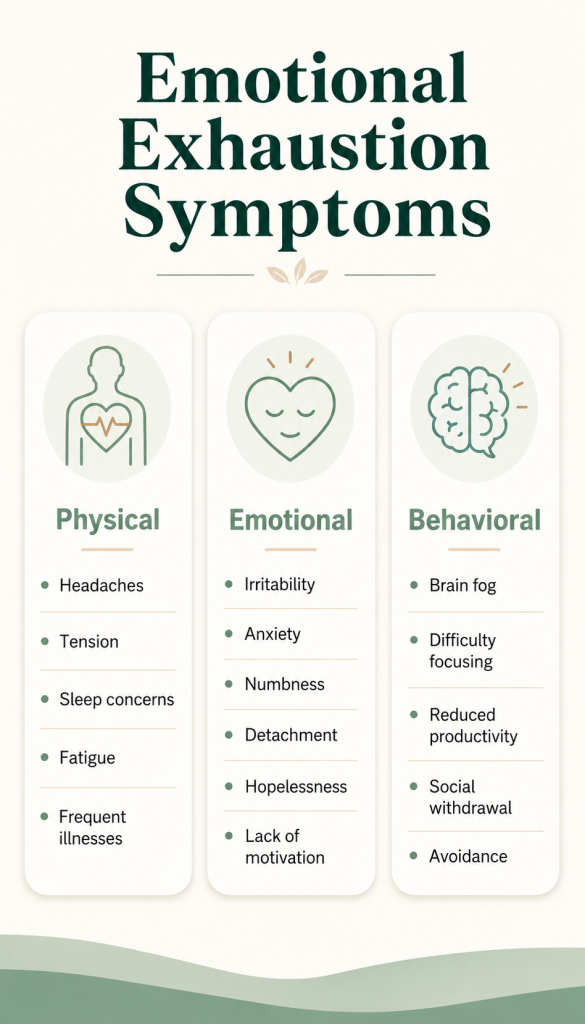
The emotional exhaustion symptoms can show up physically, emotionally, and behaviorally:

Physical Symptoms:

  • Chronic fatigue
  • Sleep disturbances
  • Appetite changes
  • Tension headaches
  • Falling sick more often.

Emotional Symptoms:

  • Irritability
  • Anxiety
  • Emotional numbness
  • Detachment
  • Lack of motivation

Behavioral Symptoms:

  • Difficulty focusing
  • Brain fog
  • Reduced productivity
  • Social withdrawal
  • Going through daily routines on autopilot

Can You Be Emotionally Exhausted and Still Functioning?
Functioning But Exhausted

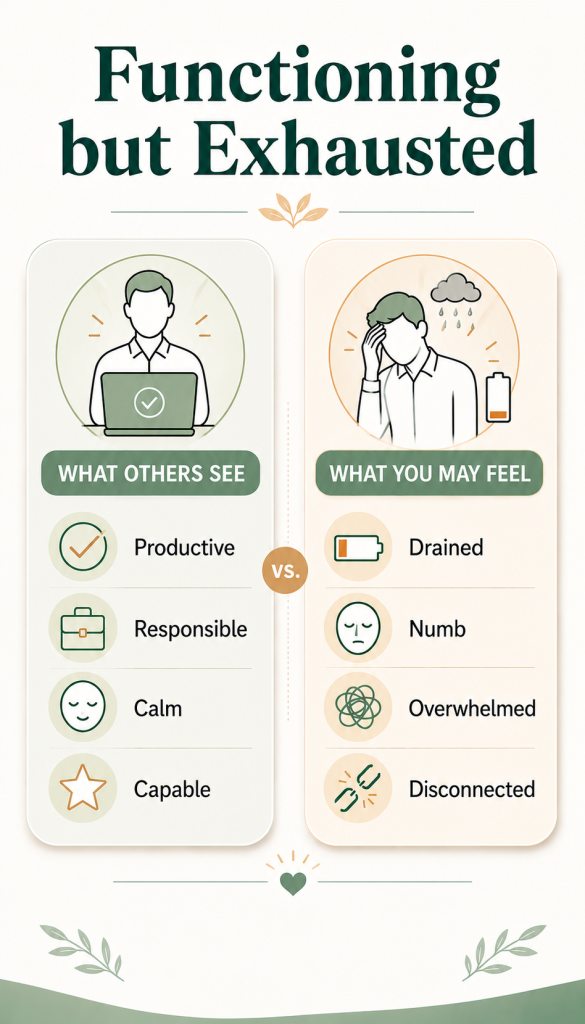
Many of those who feel emotionally exhausted continue functioning. They show up for their responsibilities and loved ones to the point that even others may see them as strong and reliable. But inside, they feel depleted, anxious, and disconnected. 

If you identify with this, functioning does not always mean you are okay. Sometimes it means you have adapted to carrying more than you can recover from. This is when you are functioning but exhausted – where you keep going because you have to, even as your emotional reserves run dangerously low.

High-functioning exhaustion often looks invisible from the outside. You may still respond to messages, meet deadlines, take care of people, and handle responsibilities normally. But internally, even simple tasks may begin feeling heavier than they used to.

See What Support Could Look Like In Your Routine

You do not have to put your life on hold to seek the care you need and deserve. Speak confidentially with licensed mental health practitioners to understand what level of care fits into your life and routine seamlessly

Why Emotional Exhaustion Builds for Wives, Mothers, and Working Professionals?

In today’s society – there are two contrasts. On the one hand, women are entering the workforce in unprecedented numbers, and on the other hand, they still have to bear a disproportionate share of household and caregiving responsibilities.

For many women in these roles, emotional exhaustion builds naturally from this push and pull of daily life. You carry the mental load – remember planning meals, tracking everyone’s needs, and the other things of life. Even when you finally have time to rest, your mind may still feel responsible for everything around you.

You also become responsible for others’ physical and emotional needs, even as you have to manage your own. Such demand for perfection can leave women gasping for breath at every turn of life – but you keep pushing forward.

For working professionals, where multitasking is the demand of the day, managing tasks at work and also at home can also feel more demanding when responsibilities keep increasing on both ends. When everything depends more on you, it can become easy to ignore how much you are carrying.

Why Emotional Exhaustion Builds Gradually?

Emotional Exhaustion Progression

Emotional exhaustion does not happen overnight – it builds quietly as you are still functioning on the outside. It mainly develops because of:

  • Prolonged periods of stress, even low stress
  • High demands and expectations
  • Emotional labor
  • Constant decision-making
  • Lack of a true recovery period.

The slow increase makes it easy to overlook. You tell yourself everything is looking fine, it must be fine. You are not on the verge of a breakdown or a crisis yet, but functioning while depleted still does not have to be overlooked or pushed down.

Emotional Exhaustion vs Burnout: What’s the Difference?

Emotional exhaustion and burnout are related, but they are not identical.

Emotional exhaustion primarily means feeling mentally and emotionally depleted.

Meanwhile, burnout is a broader pattern that includes emotional exhaustion, among other symptoms like reduced motivation, cynicism, detachment, and difficulty feeling ineffective.

Emotional exhaustion may be one of the earlier signs of a burnout, which is why it must not be ignored. 

Parameter Emotional Exhaustion Burnout
Feeling drained Feeling emotionally drained Feeling depleted and detached
Recovery potential It may improve with rest and support It requires deeper lifestyle changes and care
Timeline It is an early warning sign. It is a longer-term pattern.

When Emotional Exhaustion Becomes Harder to Ignore

At some point, rest and the other coping mechanisms you may be using to bury your emotional exhaustion will no longer be effective the way they used to. Anxiety and depressed feelings increase as you feel detached from daily life. You become less patient, as responsibilities feel just as heavy. You begin to feel like you are close to shutting down.

It may not feel like a crisis, but it may be a sign that you need more care than you have right now.

Talk Through What Kind Of Support Could Help You Feel More Stable

Speak with licensed and experienced mental health practitioners to understand what kind of care can make you feel more stable if you have been experiencing emotional exhaustion symptoms

What Helps When You Feel Emotionally Exhausted?

Recovery from emotional exhaustion usually involves reducing overload while rebuilding emotional and mental recovery habits consistently over time. What actually helps includes:

  • Setting boundaries
  • Reducing overload where possible
  • Improving sleep and recovery habits
  • Talking to a therapist
  • Creating structure in your days
  • Seeking out care before things become unmanageable.

Structure and care for emotional exhaustion do not have to mean stepping away from your life completely. For many, especially when you reach out early, structured outpatient support can provide structure while they continue managing daily responsibilities.

When More Support May Make Sense

You do not have to wait until you completely burn out to ask what kind of support could help. Some of your options are:

  • Weekly therapy for opening up and learning practical tools
  • An intensive outpatient program provides more structured yet flexible support that can fit into your daily life
  • A partial hospitalization program offers a higher level of daytime care for more severe concerns – but it still allows you to return home at night.

While many often begin with weekly therapy, more structured options are also available when weekly therapy does not feel enough.

You Do Not Have to Keep Running on Empty

You deserve to feel more than just functional. You deserve moments where you are not just surviving the day but actually present in your life. Feeling emotionally exhausted does not mean you are falling behind or failing; it means that you have been strong for a long time. Now is the time to listen to what your mind and body are telling you. 

A significant next step will be to get clarity on your options to understand what level of care will make sense for you and how it can fit into your daily life.

Get Clarity On Your Options - No Pressure, Just A Conversation

Speak with mental health specialists to understand your experiences and explore what care options can make sense for you - without having to commit to anything right away
faq

Frequently Asked Questions

What does emotional exhaustion feel like?

Emotional exhaustion feels like you are constantly drained mentally and emotionally - even after a period of rest.

Many continue to show up for their responsibilities and loved ones, even while feeling emotionally exhausted from within.

Emotional exhaustion is one of the earlier signs of burnout, whereas burnout is a larger pattern that is also characterized by deeper detachment, cynicism, and reduced motivation.

Emotional exhaustion develops after periods of prolonged stress where you are expected to show up and perform, and responsibilities just do not let up.

Recovery from emotional exhaustion may involve setting boundaries, learning stress management, and creating structured routines that focus on healing and stability.

When emotional exhaustion does not improve even after rest and begins to affect your daily life, it may be an indication that you need to reach out for the care you need and deserve.

About the Writer
Clinical Director, Skyline Recovery Center

Sheldon Cohen is a licensed family and marriage therapist and the Clinical Director at Skyline Recovery Center. He believes in blending clinical expertise with a strong commitment to mentoring the next generation of therapists. From adolescent IOPs to adult behavioral health care, he believes in personal growth – whether it is found in making meaningful connections, building strong clinicians, or even in staying grounded in your personal interests.