

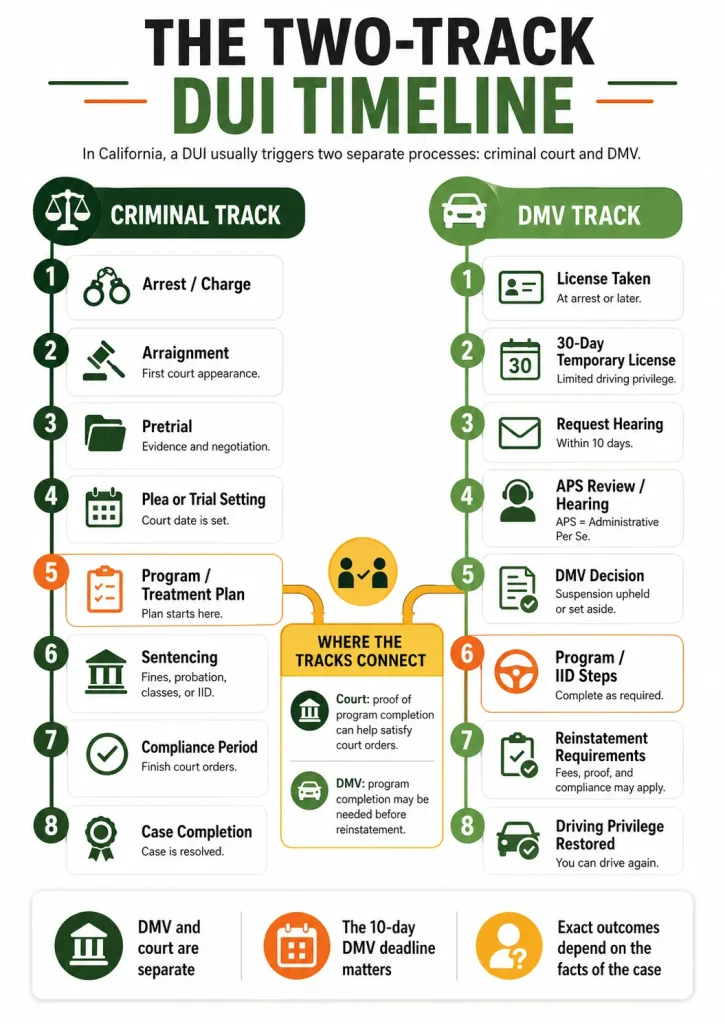
A California DUI can create two separate problems at the same time: a criminal court case and a Department of Motor Vehicles (DMV) licensing action.
Those two processes can move on different timelines.
You may be dealing with a criminal case involving Vehicle Code 23152, while the DMV separately determines whether your driving privilege should be suspended or restricted. Completing treatment can be important, but treatment by itself does not automatically restore your license or resolve the criminal case.
That is why understanding the two tracks—and acting quickly—is important after a DUI.
If alcohol use is part of the bigger picture, DUI rehab may also be an opportunity to address the underlying problem rather than treating the court requirement as paperwork to complete.
Important: California DUI, DMV, licensing, and sentencing requirements can vary based on the circumstances of the offense, prior convictions, age, injury, chemical-test results, and other factors. This article provides general information, not legal advice.
Two Clocks: The Court Case and the 10-Day DMV Deadline

After a DUI arrest, you may have both a criminal proceeding and a DMV administrative action.
The DMV process is often referred to as an Administrative Per Se (APS) hearing.
You generally have 10 days after receiving the DMV suspension or revocation notice—often served at the time of arrest—to request an administrative hearing if you want to challenge the administrative action. Failing to request the hearing within the applicable timeframe can allow the suspension or revocation process to move forward without that hearing.
This deadline is separate from your criminal court date.
That means you should not assume:
“My first court date is next month, so I have plenty of time.”
The DMV clock may already be running.
The Criminal Track
The criminal case may involve:
- Arraignment
- Plea negotiations
- Court appearances
- Sentencing
- Probation
- DUI education
- Treatment
- Fines and fees
- Other court-ordered conditions
- Victim impact panel, when ordered
For a DUI involving alcohol, Vehicle Code 23152 is one of the central California statutes governing driving under the influence.
The DMV Track
The DMV process is separate.
Depending on the circumstances, the DMV may take administrative action against your driving privilege.
You may therefore need to address:
Court requirements + DMV requirements
Completing one does not automatically complete the other.
The APS Hearing and the Restricted License
The Administrative Per Se hearing is the DMV process associated with qualifying DUI arrests, including cases involving chemical-test results or an alleged refusal or failure to complete required testing.
The purpose is different from the criminal prosecution.
The DMV is dealing with your driving privilege, while the criminal court is dealing with the criminal case.
If you request the hearing within the applicable deadline, you may be able to challenge the DMV’s administrative action.
The exact issues considered at an APS hearing depend on the circumstances of the arrest and the applicable law.
Because the deadline can be short, contacting a California DUI attorney quickly can be important.
What About a Restricted License?
A restricted or limited driving privilege may be available in some circumstances, but eligibility depends on factors such as:
- The type of DUI
- Prior DUI history
- Whether you meet applicable DMV requirements
- Enrollment in an approved DUI program
- Insurance requirements
- Ignition interlock requirements
- Any applicable court restrictions
A restricted license does not mean you can drive anywhere for any reason.
The restrictions depend on the type of license or driving privilege issued.
Do not assume that completing treatment automatically gives you permission to drive.
DUI School vs. Treatment: 3, 9, 18, 30-Month Programs
One of the biggest areas of confusion after a DUI is the difference between DUI school and substance use treatment.
They can overlap, but they are not necessarily the same thing.
California’s DUI program system includes different program lengths depending on the circumstances of the offense and the person’s history.
Common program durations include:
- 3-month program
- 9-month program
- 18-month program
- 30-month program
The appropriate program depends on the individual’s circumstances and the requirements imposed by the court and/or DMV.
California’s Department of Health Care Services (DHCS) licenses and regulates DUI programs, and the state maintains requirements for providers serving DUI offenders.
DUI School
A DHCS-licensed DUI program may provide education, counseling, group sessions, and other services required under California’s DUI program system.
Completing the required DUI program can be an important part of satisfying DMV or court-related requirements.
California DHCS does not license internet-only DUI programs, so an online class should not be assumed to satisfy a California DUI-program requirement.
But DUI school may not address every person’s clinical needs.
Treatment Is Different
Someone with an alcohol use disorder may need treatment beyond the educational requirements of a DUI program.
Depending on the person’s assessment, treatment could include:
- Outpatient counseling
- Intensive outpatient treatment
- Residential treatment
- Individual therapy
- Group therapy
- Medication treatment when clinically appropriate
- Medically supervised detox
If someone is physically dependent on alcohol, abruptly stopping can sometimes cause dangerous withdrawal. Medically supervised detox may therefore be appropriate for some people rather than attempting to stop drinking without medical support.
You can learn more about alcohol addiction treatment if you are concerned that a DUI is connected to a larger drinking problem.
Ignition Interlock and SR-22 in Plain Terms
Two terms you’ll often encounter after a California DUI are ignition interlock device and SR-22.
They are not the same thing.
Ignition Interlock Device
An ignition interlock device (IID) is a breath-testing device installed in a vehicle.
The driver generally has to provide a breath sample before the vehicle can start. California DMV explains that an IID may be required following certain DUI offenses and that requirements depend on the driver’s circumstances.
The purpose is to prevent someone with alcohol in their system from starting the vehicle.
If an IID is required, you must follow the applicable installation, maintenance, and reporting requirements.
SR-22
An SR-22 is proof of financial responsibility filed with the DMV by an insurance company.
It is not a special type of insurance policy.
Instead, it demonstrates that the driver has the required liability coverage.
If an SR-22 is required, allowing the policy to lapse can create additional DMV problems.
Treatment Doesn’t Replace Either Requirement
Completing treatment does not automatically eliminate an IID requirement.
Likewise, treatment does not substitute for required insurance documentation.
Think of these as separate pieces of the process:
Treatment → health and court-related requirements
IID → driving-related requirement
SR-22 → financial responsibility requirement
You may have to satisfy several of them at the same time.
Why Voluntary Treatment Before Sentencing Matters
You do not necessarily have to wait for a judge to order treatment before taking your drinking seriously.
If you already recognize that alcohol has become a problem, voluntarily seeking an assessment or treatment can be an important step.
That does not guarantee a particular legal outcome.
Your attorney is the person who can explain whether voluntary treatment may be relevant to your particular case, plea negotiations, sentencing, or probation.
From a health perspective, however, treatment does not have to wait for a court order.
Someone can seek help because:
- They are worried about another DUI
- They cannot reliably control how much they drink
- They drink despite consequences
- Family relationships are being affected
- They experience withdrawal symptoms
- They want to stop drinking safely
- They are concerned about returning to the road
What About a Drug Court Program?
Drug court is a specialized collaborative court model and should not be confused with every DUI treatment requirement.
If your case involves a specialized treatment court, follow the requirements of that particular program.
Similarly, completing court ordered rehab does not necessarily satisfy every DMV requirement.
The court and DMV have different roles.
Watson Advisement and DUI Sentencing
You may also encounter the Watson advisement in California DUI cases.
The Watson advisement warns that driving under the influence is extremely dangerous to human life and that if a person later drives under the influence and kills someone, the person can potentially face a murder charge.
The advisement is part of California’s DUI legal framework and is not a substitute for treatment or an assessment.
If you are unsure what your sentencing documents require, have your attorney explain each condition before assuming you have completed everything.
Repeat Offenses: When Residential Treatment May Be Recommended or Required
A first DUI does not automatically mean residential treatment.
Likewise, a repeat DUI does not automatically mean that residential treatment will be appropriate in every situation.
Treatment recommendations should consider the person’s clinical needs.
An assessment can evaluate factors such as:
- Alcohol consumption pattern
- Withdrawal risk
- Previous treatment
- Previous relapse
- Medical needs
- Mental health conditions
- Recovery environment
- Ability to remain abstinent in an outpatient setting
- Risk of continued substance use
For someone with significant alcohol dependence, medically supervised withdrawal management may be needed before longer-term treatment.
Someone else may be appropriate for outpatient or intensive outpatient care.
When Is Residential Treatment More Appropriate?
Residential care may be considered when someone needs a structured environment and cannot safely or reliably maintain recovery in a less intensive setting.
The important distinction is:
Court requirement ≠ clinical assessment
A court may require treatment, while a qualified clinical professional determines what level of treatment is appropriate.
If the court or probation conditions require a particular program or level of care, discuss any proposed change with your attorney and supervising authority before leaving or transferring.
Getting Back on the Road Requires Several Steps

After a DUI, it is tempting to think of treatment as the final step before getting your license back.
In reality, several requirements may need to line up.
Depending on your circumstances, you may need to address:
- DMV action
- APS hearing requirements
- DUI program enrollment
- Treatment
- Probation conditions
- Ignition interlock requirements
- SR-22 insurance
- Court fines and conditions
- Required testing
- Other sentencing requirements
That is why keeping documentation matters.
Save your:
- DUI program enrollment documentation
- Treatment enrollment records
- Attendance records
- Completion certificate
- Insurance documentation
- IID records
- Court paperwork
- DMV correspondence
If you’re unsure what treatment program you need or how to begin, you can review the admissions process and speak with the treatment team about your options.