
If you have been told that you may be eligible for drug court in Los Angeles County, the process can sound confusing at first. You may hear terms such as screening, probation, treatment phases, status hearings, sanctions, testing, graduation, and dismissal without knowing how they fit together.
Los Angeles County’s Adult Drug Court is a collaborative treatment model involving the court, prosecution, defense, probation, and substance use disorder treatment providers. The program is designed for eligible defendants with substance use needs and combines judicial supervision with treatment and rehabilitation services. Learn more about our approach to recovery on our About Us page.
Importantly, not every person charged with a drug-related offense automatically qualifies. Eligibility, treatment requirements, timelines, and consequences can depend on the specific case and the program involved.
If you’re considering treatment because of a criminal case, understanding the process before enrolling can help you avoid surprises.
Am I Eligible: The Charge and Prior Screens LA Uses

Eligibility is one of the first questions people have.
Los Angeles County’s Adult Drug Court program states that it is available to nonviolent defendants arrested for certain felony drug charges. The program describes a screening process that includes an interview, criminal-history review, and an assessment of eligibility before qualified defendants are placed into court-supervised treatment. If you are ready to explore treatment options, you can learn more about the admissions process.
That means having a substance use disorder does not automatically qualify someone for the program.
The court and participating agencies may consider factors such as:
- The specific criminal charge
- Whether the offense falls within the program’s eligibility requirements
- Criminal history
- Prior convictions or cases
- Risk and treatment needs
- Substance use disorder assessment
- Whether the defendant is appropriate for a collaborative treatment model
- Other legal circumstances surrounding the case
The Los Angeles County Adult Drug Court program is part of a broader network of collaborative courts, which bring together judicial supervision and treatment services rather than relying exclusively on traditional incarceration. California courts describe adult drug courts as evidence-based collaborative justice programs intended to address substance use and related issues while maintaining close court oversight.
The ASAM Assessment
Depending on the treatment provider and referral pathway, treatment placement may involve an ASAM assessment to help identify an appropriate level of care.
ASAM refers to the American Society of Addiction Medicine and its criteria for evaluating the appropriate level of substance use disorder care.
An assessment can help determine whether someone needs outpatient treatment, intensive outpatient treatment, residential care, withdrawal management, or another level of support.
The important distinction is that legal eligibility and clinical treatment needs are not necessarily the same question.
A person may qualify for a court program but still need an individualized assessment to determine the appropriate treatment setting.
Getting In: Referral, Eligibility Screening, DA Review, and the Plea
Drug court generally does not work like walking into a rehabilitation center and signing yourself up.
The legal process comes first.
Los Angeles County describes its Adult Drug Court as a partnership involving the LA County Superior Court, District Attorney’s Office, Public Defender’s Office, Probation, and contracted substance use disorder treatment providers. The exact role of each agency can vary by case, and LA County Probation specifically identifies Pretrial Services as conducting interviews, criminal-history review, and eligibility assessments before qualified defendants are placed into court-supervised treatment with court approval. For more information about addiction treatment and recovery, explore our recovery blog.
A typical pathway may involve:
Criminal case → referral/screening → eligibility review → court approval → treatment → ongoing supervision
The exact sequence can vary by case.
The Los Angeles County Probation Department describes conducting interviews, reviewing criminal history, completing eligibility assessments, and verifying information before qualified defendants are placed into a court-supervised treatment and rehabilitation program with court approval.
What About the Plea?
Many adult drug courts nationally and in California operate after adjudication or a guilty plea, although diversion and pre-plea models also exist. California’s Judicial Branch explains that most adult drug courts are post-adjudication programs in which participants enter drug court after a guilty plea, while some diversion and pre-plea models operate differently.
This is an area where you should not assume another person’s drug court experience applies to your case.
Before entering a plea or accepting treatment-court conditions, discuss the consequences with your criminal defense attorney.
Questions worth asking include:
- What happens if I complete the program?
- What happens if I do not complete it?
- What charges remain if I leave?
- Will a plea be entered?
- What happens to the case during treatment?
- What are the testing requirements?
- How long is the expected treatment period?
The answers depend on the legal pathway being used.
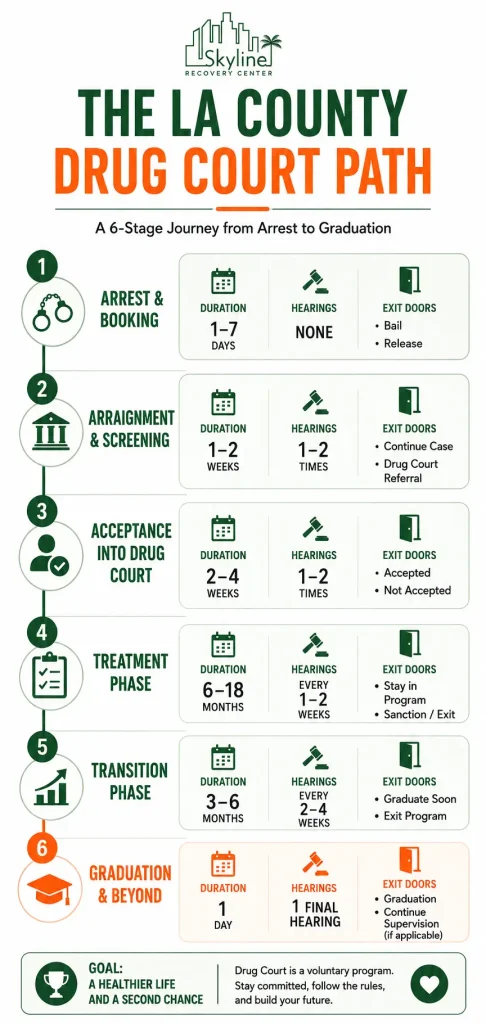
Program Stages and How Long People Stay
One thing that can make drug court different from ordinary probation is the structured progression through treatment and court supervision.
Many drug courts use formal phases, but LA County Probation’s public description of Adult Drug Court does not identify a fixed number of phases.
Programs may still use stages or milestones to reflect progress through treatment, testing, supervision, and other requirements. The exact structure and time spent at each stage can vary by jurisdiction, program, and individual case.
Los Angeles County’s current Probation information states that its Adult Drug Court program generally runs 6–9 months and includes individual and group counseling along with educational, vocational training, and job-placement components.
That does not mean every participant will have the exact same timeline.
Your treatment needs, compliance, court schedule, and case-specific requirements can affect how the process unfolds.
What Progress May Look Like
Progress in a treatment court can involve several areas:
Treatment participation:
Attending required counseling and completing treatment activities.
Substance monitoring:
Participating in testing as required.
Court participation:
Appearing at scheduled status hearings.
Behavioral change:
Demonstrating progress toward recovery and addressing factors connected to criminal-justice involvement.
Life stability:
Depending on the program, educational, vocational, employment, housing, or other supportive goals may be incorporated.
California’s Judicial Branch explains that drug courts generally combine judicial oversight, monitoring, and substance use treatment, with graduation requirements varying by program.
So the objective is not simply “stay sober until the next hearing.”
The court is typically monitoring whether you are making sustained progress while completing the conditions of the program.
Status Hearings, Sanctions and Incentives
Drug court involves more court involvement than simply receiving a treatment referral.
Status hearings allow the court to review progress. Public LA County materials do not establish one fixed hearing frequency for every Adult Drug Court participant, so the schedule should be confirmed from the specific court or program.
Depending on the program and stage of the case, the judge may receive information about:
- Treatment attendance
- Drug or alcohol testing
- Treatment progress
- Compliance with court conditions
- Employment or education
- Other required obligations
- Problems affecting participation
Los Angeles County describes its Adult Drug Court as a court-supervised program in which judges monitor participant participation.
What Happens When You Do Well?
Treatment courts generally use both accountability and positive reinforcement.
Successful participation may result in recognition, advancement within the program, fewer restrictions, or other incentives depending on the specific program.
The idea is to reinforce behaviors that support long-term recovery.
What Are Graduated Sanctions?
Drug courts commonly use graduated sanctions, meaning responses to noncompliance can increase with the seriousness or repetition of the issue rather than relying only on immediate termination. The exact sanctions available in an LA County case depend on the court and program.
Depending on the program and circumstances, responses could include:
- Increased supervision
- Additional treatment
- More frequent testing
- Additional court appearances
- Temporary restrictions
- Other court-ordered consequences
The exact response is determined by the court and program rules.
A positive test, for example, does not necessarily mean that every participant is immediately terminated from treatment court.
But that does not mean a positive test has no consequences.
The judge may consider the circumstances, previous compliance, treatment progress, and applicable program rules.
Testing Positive: What Happens Next
A positive drug or alcohol test can be frightening when your case depends on treatment compliance.
It is important not to assume that one positive result automatically means the entire program is over.
California’s collaborative drug court model emphasizes ongoing judicial supervision and treatment. Drug courts commonly use monitoring and graduated responses to address setbacks, but the exact response in an LA County case depends on the court, program rules, and circumstances.
At the same time, the consequences of a positive test are case-specific.
A positive test may lead to additional treatment, increased monitoring, a sanction, or another response depending on the circumstances.
What Should You Do After a Positive Test?
Do not disappear.
Do not skip the next treatment session because you are embarrassed.
Do not assume that avoiding the court will make the problem disappear.
Instead:
- Contact your attorney.
- Follow your treatment provider’s instructions.
- Attend your required appointments.
- Be honest about what happened.
- Ask whether additional clinical support is appropriate.
- Continue complying with other court requirements.
A relapse can indicate that your treatment plan needs adjustment.
That does not necessarily mean treatment has failed.
However, continuing to use substances without addressing the issue can create additional legal and clinical problems.
What If Alcohol Is the Problem?
Some people assume drug court only applies to illegal drugs.
The reality is more complicated.
Alcohol can be the primary substance involved in a person’s substance use disorder even when the criminal case involves another issue.
If alcohol use is interfering with your ability to comply with treatment, discuss it with your treatment team.
And if your legal case specifically involves alcohol-related conduct, such as a DUI, the appropriate program may be different.
DUI rehab can involve requirements that are separate from the Los Angeles County Adult Drug Court program, so do not assume that completing one automatically satisfies the other.
Graduation and Dismissal vs Termination
Graduation is usually the outcome participants are working toward.
But graduation is not simply the same thing as finishing a certain number of days in treatment.
The participant generally has to satisfy the applicable treatment and court requirements.
Los Angeles County Probation states that defendants who successfully complete its Adult Drug Court program have their drug case dismissed, and identifies a general program length of 6–9 months.
However, dismissal should not be assumed in every treatment-court case.
Different programs have different rules.
Graduation
Successful graduation may involve:
- Completing required treatment
- Meeting sobriety or testing requirements
- Following court conditions
- Attending required hearings
- Demonstrating sustained progress
- Completing other program requirements
California’s Judicial Branch notes that graduation requirements vary among drug courts and may include educational and job-training requirements in addition to sobriety.
Termination
Termination is different.
Someone may leave the program unsuccessfully because of serious or repeated noncompliance, failure to participate, or other circumstances defined by the program or court.
The legal consequences of termination can depend heavily on the structure of the particular case.
That is why asking “What happens if I fail drug court?” before entering the program is just as important as asking what happens if you graduate.
What About Penal Code 1203.4?
You may encounter California Penal Code §1203.4 when researching what happens to a conviction after probation.
This is a separate legal issue from simply graduating from drug court.
Penal Code §1203.4 concerns certain post-conviction relief procedures and has specific eligibility requirements and exceptions. Whether it applies to your case depends on the facts and procedural history.
Do not assume that drug court graduation automatically means a conviction is expunged under Penal Code §1203.4.
If your goal is to understand what will happen to your record after treatment, ask your attorney specifically about dismissal, expungement, record relief, and the consequences of your particular disposition.
Other Los Angeles County Treatment Courts

Drug court is only one part of Los Angeles County’s collaborative court system.
The county also has specialized programs addressing different populations and needs.
For example, Los Angeles County identifies veterans treatment court as a specialized collaborative program. The county’s Public Defender describes Veterans Court as an alternative sentencing court for eligible veterans charged with felonies or felony probation violations.
There are also programs for people with co-occurring mental health and substance use disorders.
The Co-Occurring Disorders Court, for example, is designed for people who have both mental health and substance use needs and provides court-supervised treatment tailored to those circumstances.
Proposition 36 Is Not the Same as Every Drug Court
You may also hear Proposition 36 mentioned in conversations about drug treatment and criminal cases.
Current Proposition 36 treatment-mandated felony provisions create a separate legal pathway for certain qualifying drug cases, and eligibility and consequences depend on the applicable law and case.
It should not be treated as synonymous with every Los Angeles County Drug Court program.
Likewise, Penal Code 1001.36 concerns mental health diversion, not ordinary drug court. That statute provides a framework for certain eligible defendants whose mental disorders are connected to their criminal conduct, subject to statutory requirements.
The best approach is to identify the exact program or statute involved in your case before making assumptions about eligibility or outcomes.
What If You Are Trying to Help Someone Enter Treatment?
Families sometimes ask how to get someone into rehab when a criminal case is already involved.
If the person has a court case, start by understanding the legal requirement.
Find out:
- What program has the court ordered or recommended?
- Is participation voluntary or court-mandated?
- Has the person already been screened?
- Does the court require a specific provider?
- What level of treatment is appropriate?
- What happens if the person refuses treatment?
- Who should receive progress reports?
A family member can provide encouragement and logistical support, but the legal process generally needs to be handled through the defendant, attorney, court, probation, and treatment provider.
Do not assume that privately enrolling someone in a treatment center will automatically satisfy a court requirement.
Take the Next Step With the Right Support
A criminal case can make recovery feel more complicated than it already is.
You may be dealing with court hearings, treatment requirements, testing, probation, and uncertainty about what happens next—all while trying to address the substance use issue that brought you here.
The most important thing is not simply completing a court requirement. It is using the opportunity to address the underlying substance use problem and build a stable recovery plan.
If you are already involved in a drug court program, follow the requirements of your specific case and communicate with your attorney and treatment team when problems arise.
And if you are considering court ordered rehab, do not wait until after enrollment to find out whether the program fits your legal requirements.