

When alcohol testing becomes part of a custody case, a test result can feel like it carries a simple answer: positive or negative. In reality, alcohol biomarkers such as ethyl glucuronide (EtG) and phosphatidylethanol (PEth) measure different things, use different samples, and cover different periods of time.
That distinction matters when a parent is facing court ordered rehab, monitored sobriety, or questions about parenting time. A urine EtG result may reflect relatively recent alcohol exposure, while PEth can provide information about alcohol consumption over a much longer period.
Neither test, by itself, explains the entire story of a person’s drinking or parenting ability. The laboratory method, cutoff level, timing, specimen handling, and surrounding evidence all matter.
If you’re worried about how alcohol use may affect your case, it is also important to understand that will I lose custody if I go to rehab is not a question that can be answered from a drug or alcohol test alone. Courts generally consider the broader circumstances, including the child’s safety, the parent’s conduct, treatment participation, and compliance with court orders.
What Each Test Measures and Why They Differ

EtG and PEth are both alcohol biomarkers, but they are not interchangeable.
EtG stands for ethyl glucuronide. It is a direct metabolite produced when the body processes ethanol. Urine testing can detect EtG after the alcohol itself has left the bloodstream. Laboratories may also test for ethyl sulfate (EtS), another direct alcohol metabolite.
Because EtG and EtS are eliminated relatively quickly, urine testing is primarily useful for identifying recent alcohol exposure. EtG is often detectable for roughly 1 to 3 days after drinking, although a longer window may occur in some circumstances depending on the amount consumed, the laboratory cutoff, urine concentration, individual factors, and the testing method.
PEth, or phosphatidylethanol, works differently. It is formed in blood when ethanol is present and becomes incorporated into red blood cell membranes. Rather than looking primarily at the previous few days, PEth can provide information about alcohol exposure over a period of weeks.
PEth can remain detectable for several weeks after drinking stops, although the exact window varies with drinking pattern, amount consumed, individual biology, and the laboratory method. It is therefore better understood as a longer-window alcohol biomarker than as a precise countdown from the last drink.
This difference is important:
- EtG urine: primarily recent alcohol exposure
- PEth blood: longer-term recent alcohol exposure
- EtS: often used alongside EtG to support interpretation
- PEth dried blood spot: a small blood sample collected onto a card, often called a dried blood spot (DBS)
In a custody matter, the question is therefore not simply whether one test is “better.” It is what question the court-ordered testing program is trying to answer.
Detection Windows and the ng/mL Cutoff Tiers
One of the biggest mistakes people make with alcohol testing is assuming that a detection window is a fixed countdown.
It isn’t.
An EtG result can be influenced by the amount of alcohol consumed, time since drinking, hydration, urine concentration, laboratory methodology, and the cutoff used to classify the result. A lower cutoff is more sensitive to small concentrations, while a higher cutoff reduces sensitivity but can reduce ambiguity from incidental exposure.
EtG laboratories use different screening and confirmation thresholds, so no single number should be treated as a universal positive cutoff. For example, some programs use a 500 ng/mL immunoassay screening cutoff, while definitive LC-MS/MS methods may report lower concentrations for EtG and EtS. The laboratory’s own reporting limits and the court’s testing order should control interpretation.
A useful way to think about EtG results is:
| EtG range | Possible interpretations |
| Below 100 ng/mL | May fall below some laboratories’ reporting thresholds; interpretation depends on the method and cutoff used |
| 100–500 ng/mL | Low-level EtG that may reflect drinking or incidental ethanol exposure; context is essential |
| 500–1,000 ng/mL | Can be consistent with recent alcohol exposure, but timing, amount, concentration, and incidental exposure still matter |
| Over 1,000 ng/mL | More suggestive of recent alcohol consumption, but it does not quantify impairment or parenting ability |
These are interpretive ranges, not universal legal standards. A laboratory’s methodology and the court’s testing order control how a particular result is reported.
PEth has its own commonly used thresholds. The 2022 Basel consensus uses 20 ng/mL and 200 ng/mL as important interpretive points for PEth 16:0/18:1 in whole blood:
- Below 20 ng/mL: compatible with abstinence or low alcohol consumption
- 20–200 ng/mL: alcohol consumption
- 200 ng/mL or higher: strongly suggestive of chronic excessive alcohol consumption
Those ranges should not be treated as a precise drink counter. Even current laboratory guidance cautions that PEth should be interpreted alongside other clinical and behavioral information.
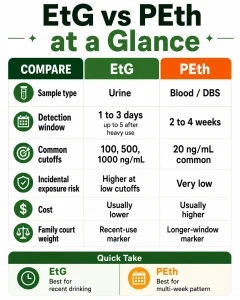
EtG vs. PEth at a Glance
| Factor | EtG Urine | PEth Blood/DBS |
| Sample type | Urine | Whole blood or dried blood spot |
| Main detection period | Usually recent use; commonly several days | Approximately 2–4 weeks, depending on drinking pattern |
| Common cutoffs | 100–500+ ng/mL depending on lab | 20 and 200 ng/mL are widely used interpretive thresholds |
| Incidental-exposure concern | Higher, particularly with very low cutoffs | Much lower concern from ordinary external exposure |
| Cost | Generally lower | Generally higher |
| Typical use in monitoring | Recent-use monitoring; context matters | Longer-window alcohol monitoring; context matters |
The monitoring row is deliberately cautious. There is no universal rule saying that a family court must give PEth more weight than EtG. The actual significance depends on the court order, expert interpretation, laboratory quality, and the rest of the evidence.
Incidental Exposure: Sanitizer, Kombucha, and Other Sources
EtG testing creates an important question: Can something other than drinking cause EtG to appear?
Yes.
SAMHSA has noted that EtG testing is highly sensitive and that exposure to small amounts of alcohol in some foods and cosmetics can affect results. Higher laboratory cutoffs can make it more likely that a positive result represents recent alcohol consumption rather than incidental exposure.
Alcohol-containing hand sanitizer is one of the best-known examples. Research has found that intensive exposure to ethanol-based hand sanitizer can produce measurable urinary EtG concentrations, particularly when exposure is frequent and the urine sample is collected soon afterward.
That does not mean an ordinary use of hand sanitizer will automatically produce a custody-test positive. The exposure scenario, amount, frequency, timing, and cutoff all matter.
Fermented foods or beverages that contain measurable ethanol may also contribute to low-level exposure in some circumstances. Kombucha is one example, but it should not be assumed to explain a positive EtG result without considering the product’s alcohol content, amount consumed, timing, cutoff, and the rest of the testing record.
This is why a low EtG result should not automatically be treated as proof of intentional drinking without considering the circumstances.
EtS can add another piece of information because it is another ethanol metabolite, but it does not magically identify the source of the alcohol exposure. A laboratory result still requires professional interpretation.
Why One Low-Cutoff EtG Cannot Decide Parenting Time
A single EtG result is a snapshot of alcohol exposure. It is not a parenting assessment.
This distinction becomes especially important when a test uses a low cutoff, because lower thresholds increase sensitivity to small concentrations. Scientific reviews have noted that lower EtG cutoffs can increase the possibility that incidental ethanol exposure becomes relevant to interpretation.
Imagine a parent receives a low-positive EtG result. That number does not automatically answer:
- When was alcohol consumed?
- How much was consumed?
- Was the exposure intentional?
- Was there incidental ethanol exposure?
- Was the sample dilute?
- Was the specimen collected and handled correctly?
- Was the result confirmed using an appropriate laboratory method?
- What does the parent’s broader testing history show?
- Was the parent impaired while caring for the child?
Those questions require context.
Depending on the case, the parties’ attorneys and, where appointed, minor’s counsel may consider testing results alongside the broader custody evidence. Toxicology interpretation itself should come from a qualified laboratory or medical professional rather than from the biomarker number alone.
This is also why court ordered rehab should not be viewed as synonymous with losing custody. Entering treatment can be evidence that a parent is taking a substance-use concern seriously. The legal effect depends on the circumstances and applicable court orders.
Likewise, someone involved in dui rehab or a drug court program may undergo testing under rules that differ from a family-court testing protocol. The purpose of the test matters.
Confirmation Testing and Chain of Custody
When a test could affect parenting time or custody, the testing process itself deserves attention.
A screening result and a definitive laboratory result are not necessarily the same thing. Where the consequences are significant, confirmatory testing using a highly specific analytical method may be appropriate.
LC-MS-MS confirmation, more commonly written as LC-MS/MS (liquid chromatography-tandem mass spectrometry), is one highly specific analytical approach. It can quantify compounds such as EtG, EtS, and PEth rather than relying only on a preliminary screening result.
For EtG, confirmation may involve measuring both EtG and EtS. For PEth, laboratories may measure specific PEth homologues such as PEth 16:0/18:1.
The chain of custody is another important consideration in forensic or court-ordered testing. It creates documentation showing how the specimen was collected, identified, sealed, transferred, stored, and analyzed.
A reliable testing record should make it possible to establish:
- Who provided the specimen.
- When and where it was collected.
- How the person’s identity was verified.
- How the specimen was sealed and labeled.
- Who handled it before laboratory analysis.
- Which laboratory performed the testing.
- What analytical method was used.
- Which cutoff levels applied.
- Whether confirmation was performed.
- Whether the specimen was considered valid.
If a result is disputed, these details can become important questions for the appropriate attorney, laboratory professional, or, where a Medical Review Officer (MRO) is part of the testing program, the MRO.