
Gen Z is often called the “sober generation,” but that label only tells part of the story. Some young adults are avoiding alcohol entirely, while others are drinking selectively and setting firmer limits around when and why they drink.
Skyline Recovery Center surveyed Gen Z adults about their drinking habits, reasons for cutting back, and approaches to moderation. The findings explore how health, finances, and changing social expectations are shaping this generation’s relationship with alcohol.
Clinically reviewed by Sheldon Cohen, LMFT, Clinical Director | Updated on: 23-09-2026
Nearly 1 in 4 Gen Z adults (24%) don’t drink alcohol.
The average Gen Z drinker has about 4 drinks per week and spends about $800 per year on alcohol.
46% of Gen Z are saving about $1,200 per year since cutting back.
Health is the top reason Gen Z drinks less (46%), just ahead of money (37%).
Daytime plans like brunches and day parties are where Gen Z most often skips a drink (35%).
Gen Z’s relationship with alcohol ranges from complete abstinence to regular drinking, with many young adults falling somewhere in between.
Nearly 1 in 4 Gen Z adults (24%) do not drink at all. Single Gen Z adults are more likely to be fully sober (30%) than those in a relationship or living with a partner (17%).
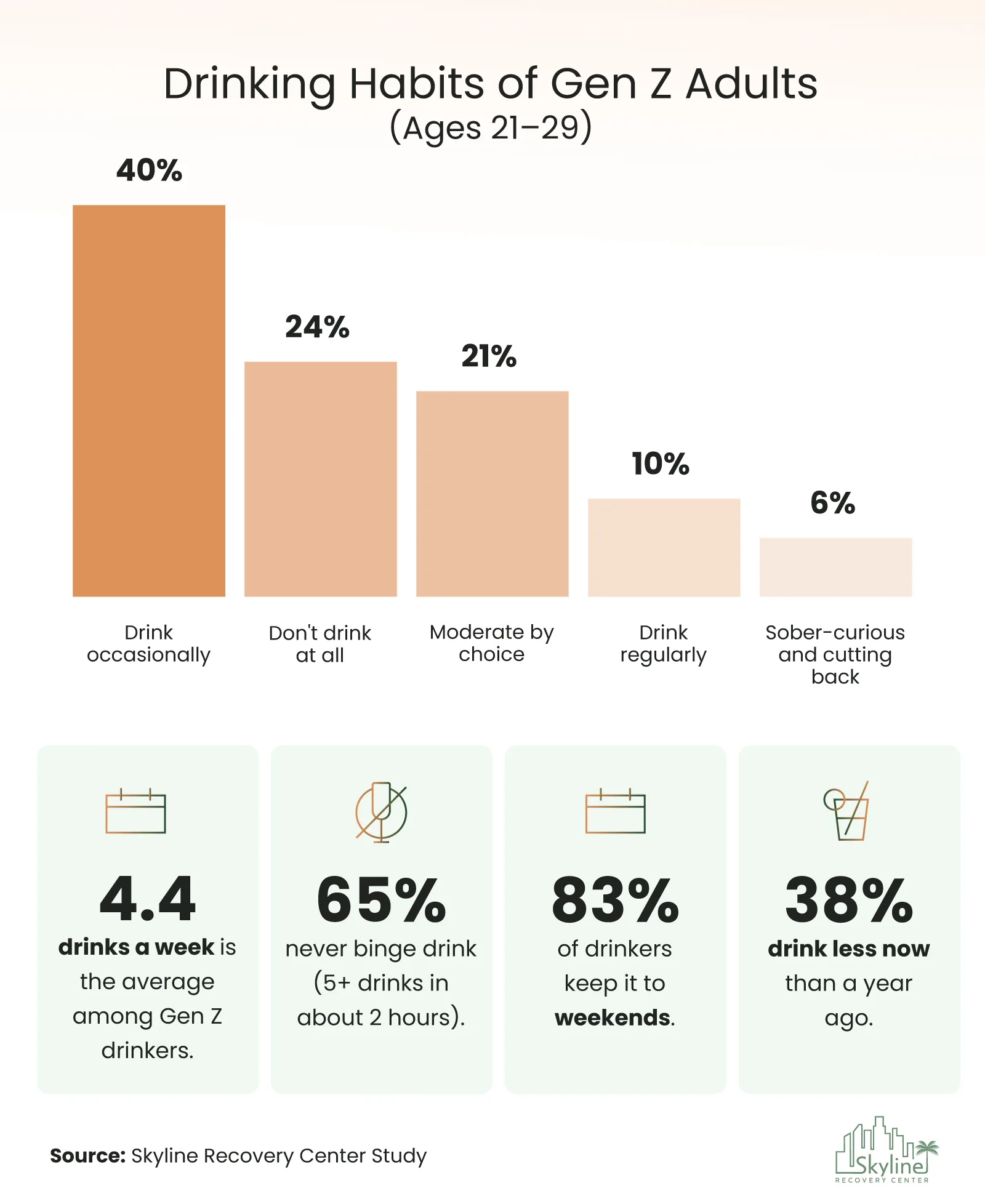
Another 6% of Gen Z adults describe themselves as sober-curious and cutting back, while 21% moderate by choice. At the same time, 40% drink occasionally, and 10% drink regularly. The figures help explain why a single “sober generation” label does not capture the full picture.
Among Gen Z adults who drink, the average is 4.4 drinks per week. Nearly two-thirds (65%) said they never binge drink, defined in the survey as having five or more drinks in about two hours, and 83% keep their drinking to weekends. More than 1 in 3 Gen Z drinkers (38%) said they drink less now than they did a year ago.
A relatively small group accounts for much of the reported consumption. Regular drinkers make up 1 in 10 Gen Z adults. They average 11.5 drinks per week, while occasional drinkers average 3.3. Nearly a third of regular drinkers (32%) binge weekly, but only 4% of occasional drinkers do.
Men report drinking more than women, averaging 5.1 drinks per week versus women’s 3.9. They are also nearly twice as likely to binge weekly (7% vs. 4%). Preferences also differ: 52% of men drink beer, compared with 24% of women. Women are more likely to choose spirits or cocktails (55% vs. 39%).
Many Gen Z adults are deciding whether to drink based on the occasion instead of treating alcohol as a default part of socializing.
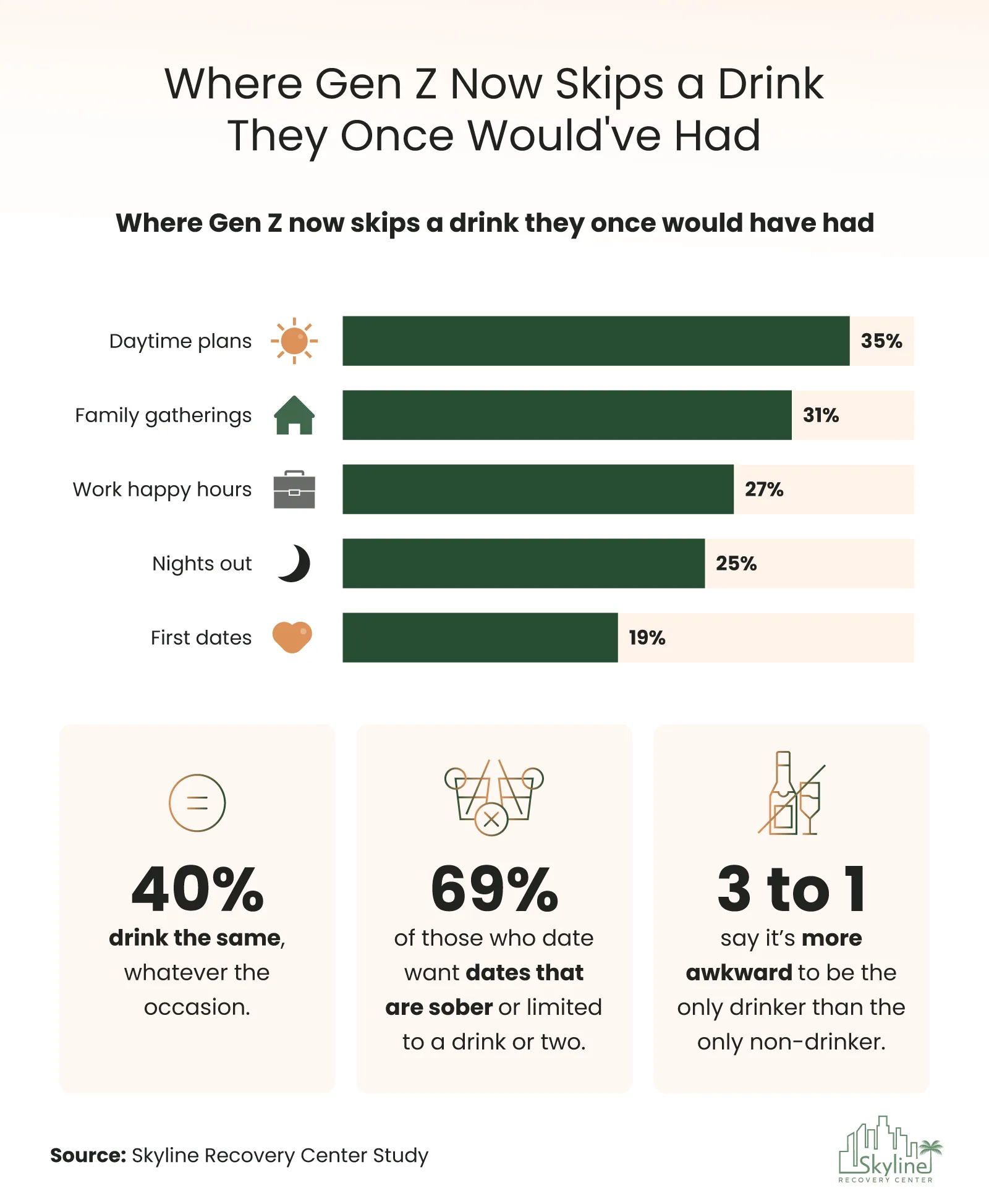
Daytime plans, such as brunches and day parties, are when Gen Z is most likely to skip a drink they once would have had (35%). Family gatherings follow at 31%, along with work happy hours (27%), nights out (25%), and first dates (19%). Still, 40% said they drink the same amount regardless of the occasion.
Dating preferences show how social expectations are changing. More than two-thirds of Gen Z adults who date (69%) want dates with little to no alcohol, while only 6% prefer dates with drinks.
Even many frequent drinkers feel the shift. More than half of moderate drinkers (51%) and 45% of regular drinkers said being the only person drinking is more awkward than being the only person not drinking.
Alcohol-free drinks and venues have not reached everyone. Nearly half of Gen Z adults (48%) have never tried one. Men are the least likely to have explored these options, with 57% saying they have tried none, compared with 44% of women. Women are nearly twice as likely as men to have ordered a mocktail or zero-proof drink (39% vs. 20%).
Some young adults also use wellness as a socially acceptable reason to opt out. More than 1 in 3 Gen Z adults (36%) have blamed health for not drinking when they simply did not want to, and that rises to 39% among single adults.
Gen Z’s reasons for cutting back often reflect the effect alcohol can have on everyday health, finances, and responsibilities.
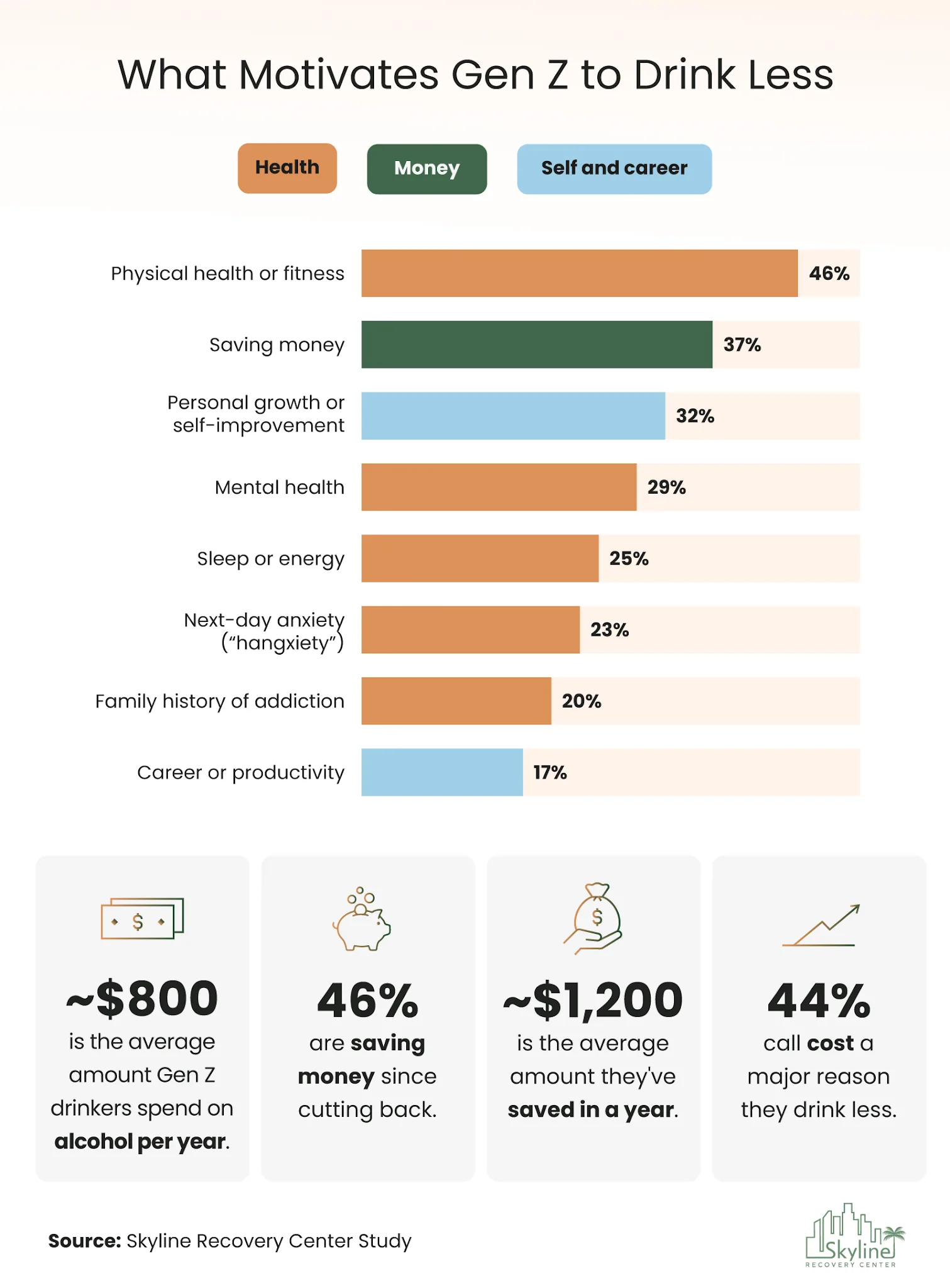
Physical health or fitness is the most common reason Gen Z cited for drinking less, at 46%. Other factors included:
The reasons become more pronounced with age. Half of adults ages 25 to 29 said health was their reason for cutting back, but fewer of those ages 21 to 24 said the same (39%). Women are also more likely than men to identify next-day anxiety as a reason to drink less (26% vs. 17%).
Gen Z drinkers spend about $800 per year on alcohol, on average. Regular drinkers spend about $121 per month, more than twice the $54 reported by occasional drinkers, and are the group most likely to name saving money as a reason to cut back (46%). Married Gen Z drinkers spend about $93 per month, while those living with a partner spend less ($55).
Nearly half of Gen Z adults who have cut back (46%) said they are saving money as a result. Among those saving, the average is about $1,200 per year.
For some, cutting back also means figuring out what takes alcohol’s place. Nearly 1 in 5 Gen Z adults (19%) said nothing has replaced drinking, and that rose to 24% among regular drinkers.
Most Gen Z adults use at least one deliberate strategy to control how much they drink, although the need for support varies considerably.
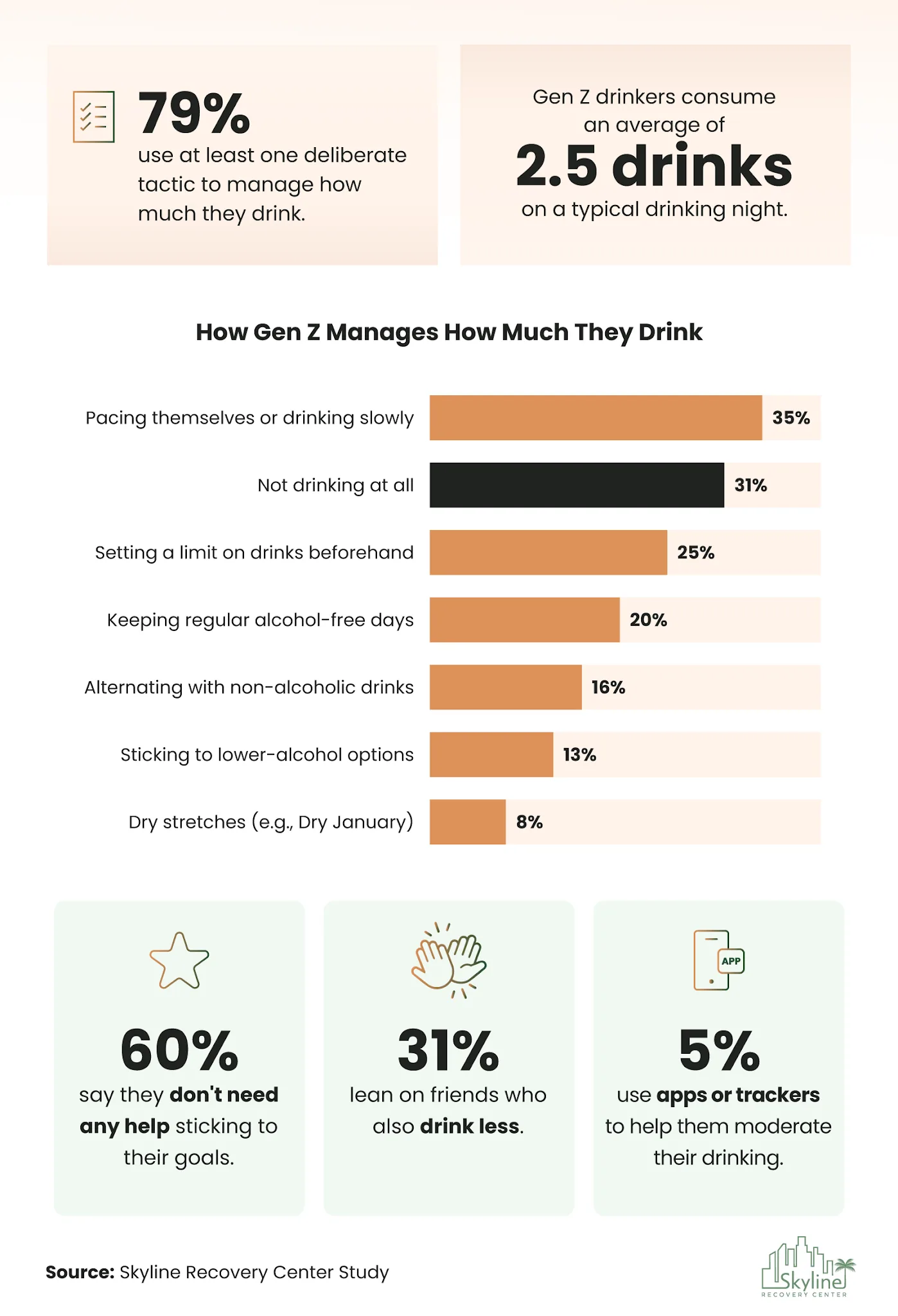
Nearly 4 in 5 Gen Z adults (79%) use at least one deliberate moderation tactic. The most common is pacing themselves or drinking slowly (35%), followed by not drinking at all (31%) and setting a limit before drinking (25%). Others keep regular alcohol-free days (20%), alternate with nonalcoholic drinks (16%), choose lower-alcohol options (13%), or take dry stretches such as Dry January (8%).
Regular drinkers are also the most likely to use strategies to moderate their drinking. Almost all regular drinkers (93%) use a moderation tactic, and 43% set a drink limit beforehand, which is higher than the overall rate (25%).
Regular drinkers are also less likely to feel that they can manage without help. Just 34% said they do not need support, compared with 60% of Gen Z overall. More than a quarter of regular drinkers (27%) said nothing has helped them stick to their goals.
Friends who also drink less are the most common source of support, cited by 31%. Formal programs or communities are used by 5%, as are apps or trackers. Younger Gen Z adults are the most likely to say they do not need help, at 65% of those ages 21 to 24 versus 57% of adults ages 25 to 29.
“Damp drinking,” or cutting back without quitting, is the most commonly tried moderation trend. One in 5 Gen Z adults (20%) has tried it, including nearly half of regular drinkers (49%). Social media appears to have less influence: 63% said sober-living content has not affected their drinking habits.
Gen Z’s relationship with alcohol can’t be reduced to a choice between drinking and sobriety. Some young adults abstain, many drink occasionally, and a smaller group accounts for a large share of reported consumption. Across those experiences, health, finances, and social comfort are shaping the boundaries people set.
For many young adults, drinking less means skipping alcohol on certain occasions, setting a limit, or choosing regular alcohol-free days. If those boundaries become difficult to maintain or alcohol starts affecting your mental health, work, or relationships, support is available before things reach a crisis point.
Recovery is not about willpower alone; it is about having the right level of care, structure, and medical oversight behind you.
Skyline Recovery Center surveyed 766 Gen Z adults, ages 21 to 29, about how much and how they drink, how they see the “sober generation” label, the occasions where they now skip alcohol, why they’re cutting back, and what helps them moderate. The sample was 62% women, 33% men, 4% non-binary or gender non-conforming, and 1% preferred not to say. By relationship status, 47% were single and never married, 21% were in a relationship, 13% were living with a partner, 18% were married, and 1% were divorced, separated, or widowed.
Respondents were asked about their current relationship with alcohol, weekly and per-occasion consumption, monthly spending and savings, motivations for drinking less, situations where they skip drinks, dating preferences, moderation tactics, and sources of support. Dollar figures are averages of monthly self-reports. Percentages that do not total 100% are due to rounding.
Skyline Recovery Center provides personalized, evidence-based mental health treatment and addiction treatment in Los Angeles. Its Partial Hospitalization Program (PHP) and Intensive Outpatient Program (IOP) offer structured support while allowing clients to continue work, school, and daily life.
You are welcome to share these findings for noncommercial purposes. Please provide an attribution to Skyline Recovery Center and a link back to this page, so readers can view the complete study and methodology.