

You show up to therapy every week, as scheduled. You explore your challenges and try the coping skills your therapist suggests. You put in the effort and want to feel better. Yet the anxiety still creeps in during quiet moments. Depression lingers despite your best attempts to reframe it. Emotional exhaustion weighs in on you, and you feel overwhelmed on the days you do not visit your therapist.
This does not mean you are doing something wrong or that therapy has failed. You may leave therapy feeling lighter for a day or two, only to notice the same anxiety, emotional exhaustion, or overwhelm returning before your next appointment. That can be frustrating, especially when you’re doing everything you’re supposed to be doing.
Why Therapy Can Be Helpful and Still Feel Incomplete?
Therapy is the cornerstone of mental health healing. Psychotherapeutic modalities like cognitive behavioral therapy, dialectical behavioral therapy, psychodynamics, etc., are some of the most widely used practices in the world for healing and well-being.
They provide a safe environment where you can explore your deep-seated thinking and emotional patterns to heal, foster coping skills, and experience personal growth.
Yet, not everyone is the same. Different persons have different needs, as mental health exists on a continuum. We have different levels of care for different needs and also more specialized focus, such as mental health support for the LGBTQ+ community.
When therapy can still be helpful but also feel incomplete, it is an indication to explore more consistent care and structure for your needs – one that offers more regular clinical oversight so that you do not feel overwhelmed between sessions or stuck in the same patterns. This is often the point when one session each week isn’t meeting your current needs.
How Do You Know When Therapy May Not Be Enough?
Weekly therapy is often an effective form of mental health care. However, some may continue to struggle with anxiety, depression, trauma, emotional burnout, or emotional overwhelm despite attending therapy consistently.
When symptoms are affecting daily life despite weekly therapy, structured care options may provide more consistent clinical oversight, skills training and application, and accountability between sessions.
This does not mean therapy is not working. It may simply mean that a different level of care can meet you where you are for your present needs. Understanding when therapy is not enough can enable you to make informed decisions regarding the next steps in your healing journey.
Signs You May Need More Than Weekly Therapy
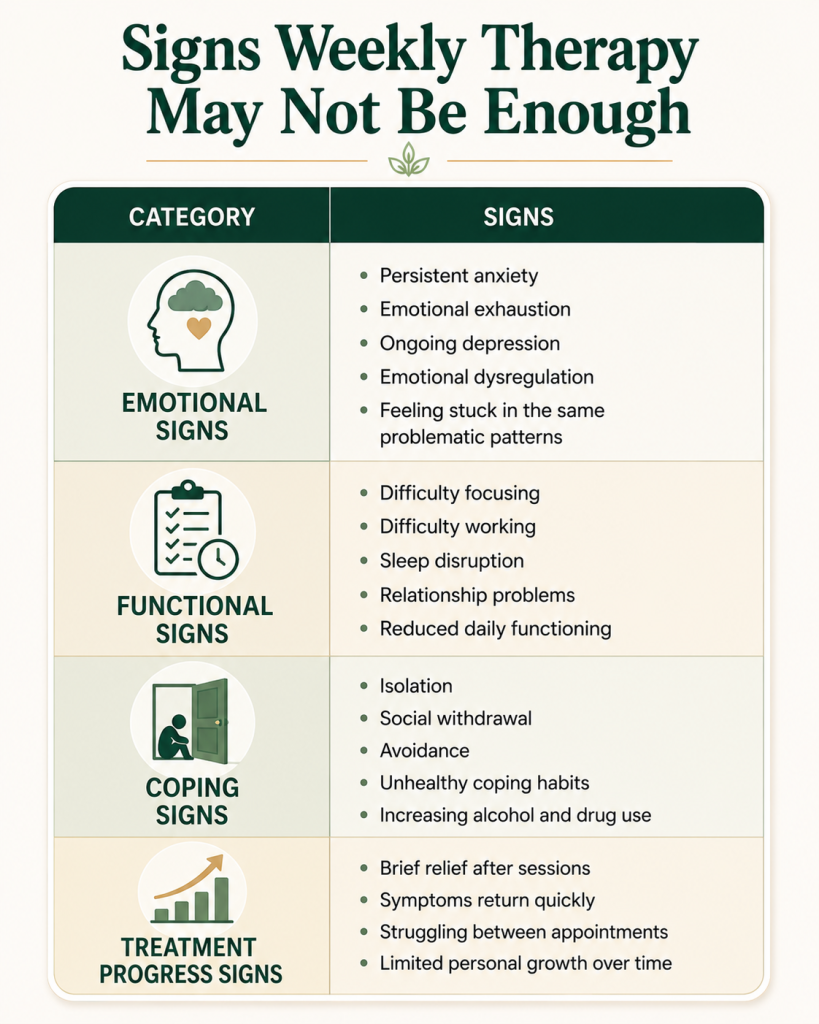
Here are some signs therapy is not enough for your present needs and goals:
Emotional Signs
- Persistent anxiety
- Ongoing depression
- Emotional dysregulation
- Emotional exhaustion
- Feeling emotionally stuck in the same patterns
Coping Signs
- Isolation
- Avoidance
- Unhealthy coping habits
- Increasing alcohol or drug use
- Emotional withdrawal
Functional Signs
- Difficulty attending school or working
- Relationship strain
- Concentration problems
- Sleep disruption
- Reduced daily functioning
Treatment Progress Signs
- Feeling better briefly after sessions
- Symptoms returning quickly
- Struggling between sessions
- Limited progress over time.
What This Can Look Like in Everyday Life
Examples:
- working professional who feels okay immediately after therapy but overwhelmed by Wednesday
- college student whose anxiety returns before next appointment
- parent managing responsibilities alone
- caregiver experiencing burnout
The concern here is not whether you are willing to improve or not putting in the effort. It means you need more consistency than one hour per week can provide, additional support may be beneficial.
Why More Support Is Sometimes Needed?
Mental health challenges often involve ongoing stressors, anxiety, depression, trauma, burnout, co-occurring substance use concerns, major life transitions such as college/university graduation, marriage, parenting, separation, or divorce, or limited social support systems. These do not always fit neatly into one-hour therapy sessions. Mental health challenges may evolve beyond what these one-hour sessions can offer.
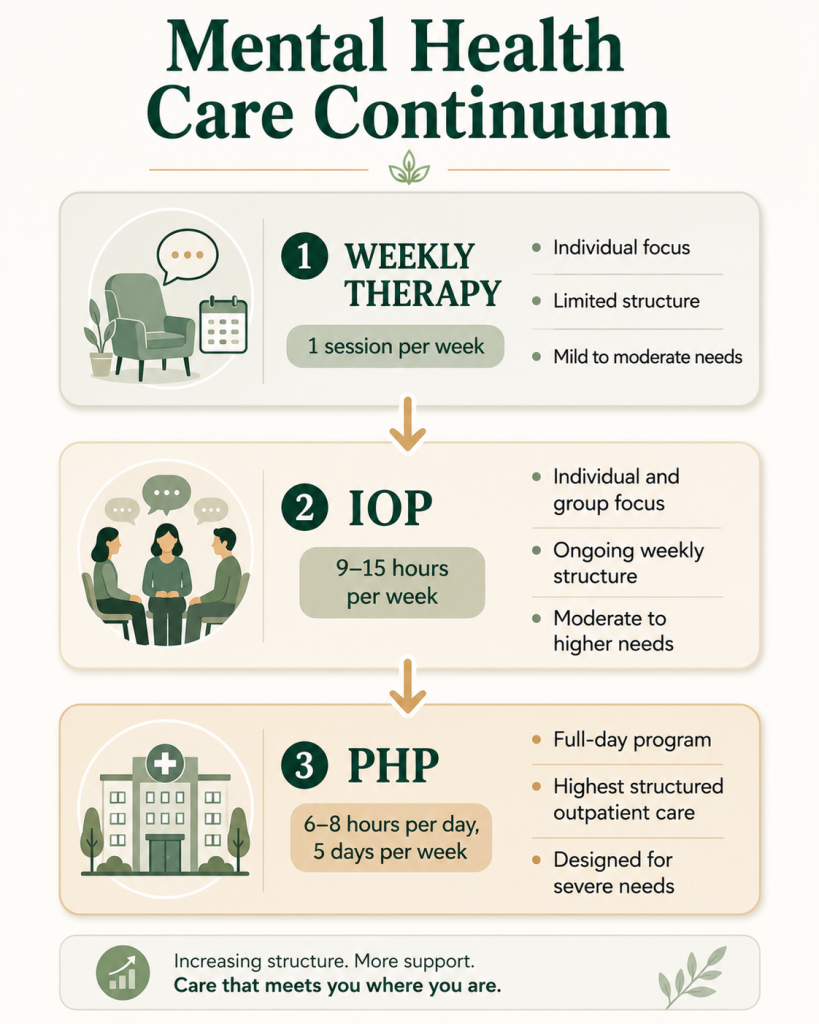
A higher level of outpatient mental health treatment, such as an intensive outpatient program or a partial hospitalization program, can bridge the gap between weekly therapy and residential/inpatient treatment, offering consistent structure and reinforcement without having to put your life on hold.
IOP vs Therapy: What’s the Difference?
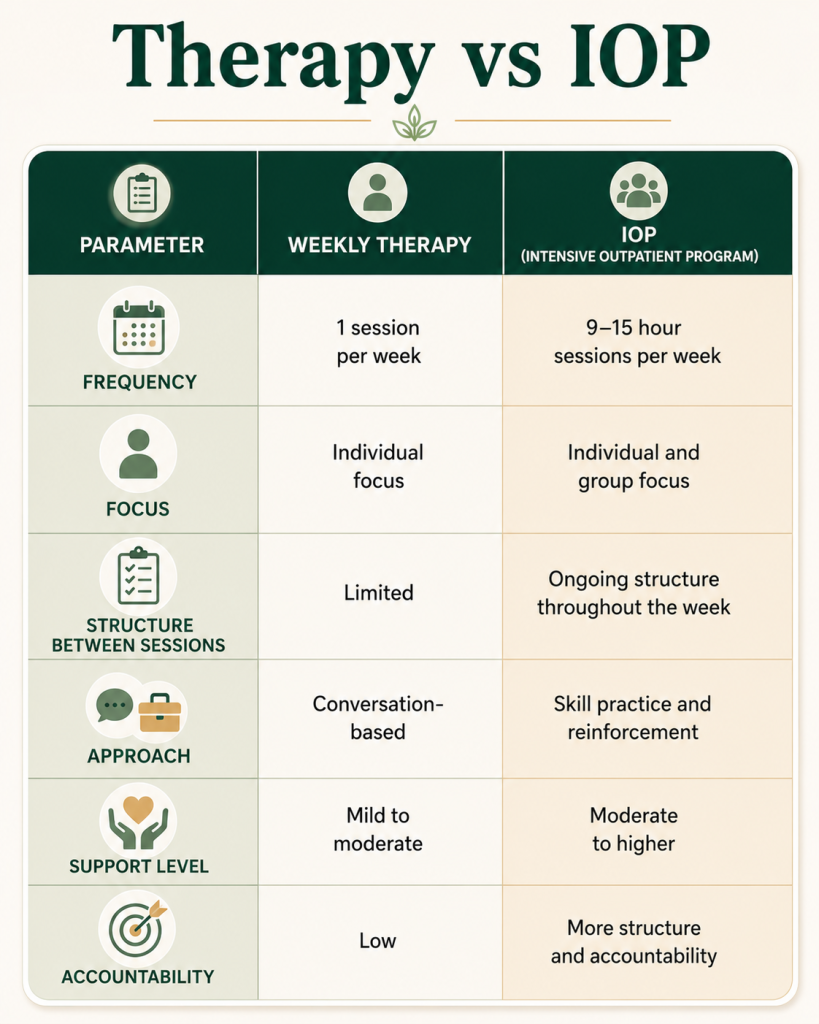
Here is an overview of the differences between therapy and intensive outpatient program (IOP) – which is the next level of outpatient care after weekly therapy. Understanding therapy vs IOP can help clarify which level of care may be the best fit for your present needs.
| Parameter | Weekly Therapy | IOP |
| Frequency | 1 session per week | 9-15 hour sessions per week |
| Focus | Individual focus | Individual and group focus |
| Support Between Sessions | Limited | Ongoing structure throughout the week |
| Approach | Conversation-based | Skill practice and reinforcement |
| Best For | Mild to moderate needs | Moderate to higher needs |
| Accountability | Low | More structure and accountability |
IOP does not replace therapy. Along with therapy, it also offers more clinical oversight with medication management, skills training, holistic healing practices, peer community, relapse prevention, and aftercare so that you can receive more consistent reinforcement throughout the week.
Rather than relying on one conversation each week, IOP gives you multiple opportunities to practice coping skills, receive feedback, and work through challenges while they are still happening. Many people find that this added consistency helps them feel more supported between therapy sessions.
When PHP May Be Recommended?
A partial hospitalization program (PHP) is the most intensive level of outpatient care. It runs for 6-8 hours per day, for 5 days per week. It offers more structure and greater clinical oversight, even though it provides the same services as an IOP. It offers a highly structured environment while allowing you to return home in the evenings.
PHP is not necessarily a “more serious” option. It simply provides a different level of care for those who benefit from greater intensity and daily engagement.
The goal is to find the level of care that best matches your present needs and not the most intensive option available.
Therapy, IOP, or PHP: Which Level of Support Fits Your Needs?
While only a licensed and qualified clinician can best determine which level of outpatient care fits your needs, here is a brief overview that will give you an idea:
Weekly therapy is best for:
- Mild symptoms
- Stable functioning outside of the therapeutic maintenance
- Ongoing maintenance of healing and personal growth
IOP is best for:
- Moderate symptoms
- Recurring challenges
- Needing more structure and also flexibility
PHP is best for:
- More severe symptoms
- Stabilization needs
- Daily treatment needs
- Flexibility to return home in the evening.
How Mental Health Professionals Determine the Right Level of Care?
Mental health specialists use assessments that consider symptom severity, daily functioning, personal goals, daily care needs, and overall circumstances. Recommendations are always personalized – based on your experiences, needs, and goals.
Rather than recommending the same level of care for everyone, mental health professionals determine the appropriate level of support through a comprehensive assessment that considers your symptoms, daily functioning, safety, previous treatment experiences, and individual goals.
For instance, a mental health practitioner can use diagnostic assessments, such as the Diagnostic and Statistical Manual of Mental Disorders (DSM-5-TR), or conduct clinical interviews to determine the best level of care for you. This will require a comprehensive psychiatric evaluation.
Getting More Support Is Not Taking a Step Back
When you realize you may need more care and structure than weekly therapy, the immediate idea that comes to mind is residential or inpatient treatment. But this is not that.
Seeking additional care does not mean putting your life on hold. It reflects a growth mindset to understand your needs and rise to meet them, and there are structured outpatient care options that offer a bridge between weekly therapy and very intensive treatment. In fact, IOP even offers flexible scheduling and evening options so that you can stay connected to your daily life even as you receive the care you need and deserve.
Sometimes people worry that seeking a higher level of care means therapy not working or that they have somehow failed. In reality, it may simply mean that weekly therapy no longer feels sufficient for what you presently need.
However, the first step is to reach out early – to speak to mental health practitioners who will sit with you to understand your needs and goals in safe and confidential settings and recommend the best step forward for you.