

If you hold or are applying for a security clearance, you may have wondered: Can you get fired for going to rehab? For people working in defense, federal contracting, or other positions requiring a clearance, seeking substance use treatment can feel like a career risk.
But rehab and security clearance are not automatically incompatible.
The security-clearance process looks at the circumstances surrounding alcohol and drug use, how recent the conduct was, whether it has continued, and what you have done to address it. Treatment can be part of the evidence showing rehabilitation rather than an automatic reason to lose a clearance.
The Standard Form 86 (SF-86), formally the Questionnaire for National Security Positions, asks specific questions about alcohol and drug-related conduct and treatment. The applicable adjudicative guidelines also allow certain concerns to be mitigated when an individual demonstrates meaningful rehabilitation.
This article explains what the SF-86 asks, how treatment can affect a clearance review, and what to understand before discussing treatment with a Facility Security Officer (FSO). It is general educational information, not individualized legal or security-clearance advice.
Treatment Can Mitigate; Concealment Can Create a Separate Security Concern

One of the most important distinctions in a security-clearance review is between the underlying substance-use concern and what you do about it.
Alcohol-related problems or drug involvement can raise concerns under the National Security Adjudicative Guidelines. But an adjudicator considers more than the existence of a past problem. Rehabilitation, behavioral change, treatment completion, abstinence, and the likelihood of recurrence can all matter.
This is why treatment may actually strengthen the overall picture in an appropriate case.
Under SEAD 4, the National Security Adjudicative Guidelines used for national-security eligibility decisions, Guideline G addresses alcohol consumption. Alcohol-related conduct can create a security concern when it involves problematic drinking, alcohol-related incidents, or other circumstances suggesting impaired judgment or reliability.
Under the same SEAD 4 framework, Guideline H addresses drug involvement and substance misuse. It allows adjudicators to consider mitigating circumstances, including evidence that an individual recognizes the problem, has taken steps to overcome it, and has demonstrated meaningful change.
The whole-person concept is important here. A clearance decision is not supposed to be based on one isolated fact without considering the person’s overall circumstances.
But there is an equally important warning: do not confuse rehabilitation with concealment.
If the SF-86 asks about information that applies to you, intentionally providing an incomplete or misleading answer can create a separate concern involving honesty, judgment, or trustworthiness.
In other words, getting treatment is not necessarily the problem.
Failing to be truthful about relevant information can create a much bigger one.
SF-86 Sections 23 and 24 Read Line by Line
The SF-86 does not simply ask, “Have you ever been to rehab?”
The questionnaire contains specific questions about drug activity and alcohol-related treatment or counseling. The exact reporting periods and wording matter, so applicants should always review the current version of the SF-86 rather than relying on assumptions.
Section 23: Drug Activity
Section 23 is more specific than a general question about drug history. On the current OPM-posted SF-86, the questions separate recent conduct from certain “ever” questions, so the reporting period changes depending on the item.
Read Section 23 item by item:
23.1 asks about illegal use of drugs or controlled substances in the last seven years.
23.2 asks about illegal purchase, manufacture, cultivation, trafficking, production, transfer, shipping, receiving, handling, or sale of drugs or controlled substances in the last seven years.
23.3 asks whether you have ever illegally used or otherwise been illegally involved with a drug or controlled substance while possessing a security clearance.
23.4 asks whether you have ever illegally used or otherwise been involved with a drug or controlled substance while serving in specified law-enforcement, prosecutorial, courtroom, or directly public-safety roles.
23.5 asks about intentional misuse of prescription drugs in the last seven years, whether or not the prescription was issued to you.
23.6 asks whether you have ever been ordered, advised, or asked to seek counseling or treatment because of illegal drug or controlled-substance use.
23.7 asks whether you have ever voluntarily sought counseling or treatment as a result of your use of a drug or controlled substance.
This means someone should not assume that treatment is irrelevant simply because there was never an arrest or criminal charge.
A person may have a legitimate treatment history without having a criminal record.
The important question is what the SF-86 actually asks and whether the individual’s circumstances fall within that specific item. Applicants should use the current form and answer each question according to its own wording and reporting period.
Section 24: Alcohol Use
The alcohol section similarly goes beyond arrests and DUI offenses.
The SF-86 asks about certain alcohol-related circumstances, including whether a person has been ordered, advised, or asked to seek counseling or treatment because of alcohol use.
Where the question applies, the form can require additional information about treatment, including details such as when and where it occurred.
That distinction matters.
Someone may never have been arrested for drinking and still have information that must be disclosed because of a treatment or counseling history.
The safest approach is to read the question literally and answer according to the applicable reporting period, rather than deciding that something is irrelevant because it did not result in a legal problem.
How Guideline G and H Mitigation Is Applied

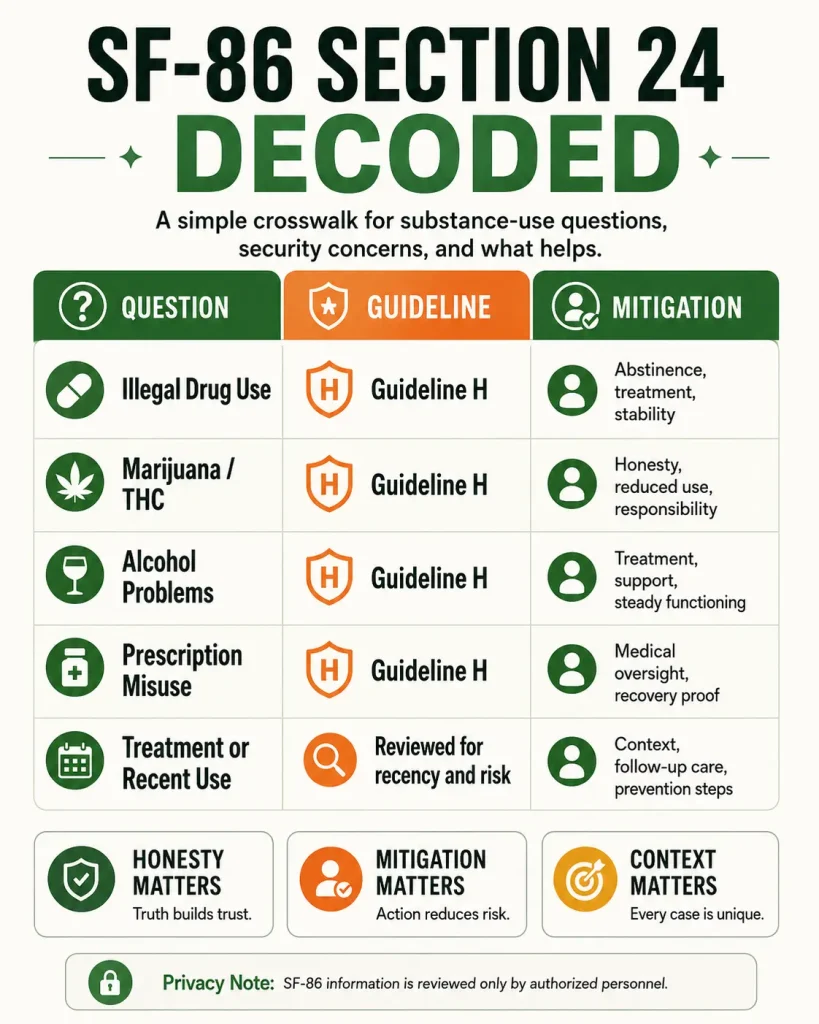
Can You Get Fired for Going to Rehab?
This is one of the biggest concerns people have when searching “can you get fired for going to rehab.”
A security clearance and employment status are related but are not the same thing.
Whether an employee can be terminated for seeking treatment depends on the circumstances, employer policies, applicable employment laws, job requirements, and the individual’s situation.
The fact that treatment may be relevant to a security-clearance review does not by itself establish that an employer will terminate someone.
Federal employment protections and leave laws can also become relevant in some circumstances. For example, FMLA for rehab may be an important issue for an eligible employee seeking treatment, although FMLA eligibility and coverage depend on the employee, employer, and medical circumstances.
If your concern is specifically about job protection, leave, or an employer’s response to treatment, consider obtaining advice from an employment attorney or qualified HR professional rather than assuming that a clearance rule determines your employment rights.
The same principle applies in reverse: employment protection does not automatically determine security-clearance eligibility.
Telling Your FSO: Timing and Vetting Flags

A Facility Security Officer (FSO) is an important point of contact for employees working for cleared defense contractors.
DCSA provides guidance for applicants completing background-investigation forms and directs individuals to their FSO for assistance with the security-clearance process.
There is an important distinction between SF-86 disclosure and continuing self-reporting obligations:
Information you must provide on the SF-86, and
A separate obligation to self-report a particular event.
Those requirements are not identical. SEAD 4 governs adjudicative considerations, while SEAD 3 addresses continuing reporting requirements for covered personnel with access to classified information or sensitive positions.
Clearance holders have continuing self-reporting obligations. DCSA lists Substance Abuse Counseling among events that may require self-reporting and directs DoD contractors to report through their Facility Security Officer. The exact reportable facts and procedure still depend on SEAD 3, agency or company security procedures, and the circumstances of the counseling or treatment.
Do not assume that completing the SF-86 satisfies every later reporting obligation.
For DoD contractors, contact your FSO promptly when a potentially reportable event occurs; federal civilians and military members should use their agency or command security channel. If the scope of the requirement is unclear, ask the appropriate security office rather than withholding the information.
The objective should be accurate and complete disclosure, not trying to predict which answer will produce the best outcome.
What Treatment Records Enter the File?
Another common concern is whether going to treatment means your entire medical history will automatically become part of your security-clearance file.
Not necessarily.
The background-investigation process can involve requests for additional information when relevant to a particular concern. What information is requested depends on the circumstances and applicable procedures.
Treatment-related documentation can sometimes help establish the recovery timeline.
Depending on the situation, relevant records may include:
Treatment dates
Completion of a treatment program
Participation in recommended aftercare
Compliance with professional recommendations
Continued recovery support
Evidence of sustained abstinence
Favorable prognosis when clinically appropriate
This does not mean you should automatically submit every medical record you have.
If you are unsure what information should be disclosed or provided, seek guidance from the appropriate security official or qualified attorney.
What About VA Substance Abuse Treatment?
For veterans, VA substance abuse treatment may raise understandable questions about how documented care fits into a clearance review.
Receiving care through the Department of Veterans Affairs does not, by itself, determine whether someone will retain or obtain a security clearance. As with treatment received elsewhere, adjudicators consider the underlying conduct, recovery evidence, current reliability, and the complete record.
The relevant question remains what information must be disclosed, what concern is being evaluated, and what the complete circumstances show about current reliability and risk.
If you are researching VA substance abuse treatment while also considering additional recovery support, alcohol addiction treatment can be discussed as part of a broader care plan. Clearance questions should be addressed separately with your FSO, security office, or a qualified security-clearance attorney.
If It Goes Badly: Statement of Reasons and Appeal

A security concern does not necessarily mean the process is over.
For certain Department of Defense contractor cases, the Defense Office of Hearings and Appeals (DOHA) handles administrative proceedings involving security-clearance eligibility.
If an applicant receives a Statement of Reasons (SOR), the document identifies the security concerns being raised.
The applicant may then have an opportunity to respond with evidence and arguments addressing those concerns. In covered industrial-security cases, either side may request a DOHA hearing before a DOHA Administrative Judge; if no hearing is requested, the matter can be decided on the written record.
Depending on the facts, evidence may include:
Treatment completion records
Evidence of continuing recovery
Documentation of abstinence
Professional recommendations
Evidence that problematic behavior has stopped
Explanation of past circumstances
Evidence of changed behavior
Information addressing the likelihood of recurrence
The goal is not simply to say, “I went to rehab.”
The stronger question is whether the evidence demonstrates meaningful rehabilitation and reduced future risk.
DOHA cases also illustrate why the whole-person approach matters. An adjudicator can consider the entire record, including positive evidence of rehabilitation alongside negative or unresolved information.
If you receive an SOR or another unfavorable security-clearance determination, pay close attention to the response deadlines and available appeal procedures. A qualified security-clearance attorney can help you understand the process and determine what evidence is appropriate for your circumstances.
Recovery Does Not Automatically End Your Clearance Career
The idea that rehab and security clearance cannot coexist is too simplistic.
Seeking treatment does not automatically mean losing a clearance.
At the same time, treatment does not guarantee that a clearance concern will disappear.
The security-clearance process considers the underlying conduct, the circumstances surrounding it, the individual’s response, rehabilitation, honesty, current behavior, and the likelihood of recurrence.
That is why seeking appropriate treatment can be an important part of changing the circumstances that created concern in the first place.
If you are worried that asking for help will automatically destroy your career, it is worth separating three different questions:
What does the SF-86 require me to disclose?
What reporting requirements apply to my clearance or position?
What employment protections or obligations apply to my job?
Those questions can have different answers. Explore your treatment options can help you make a more informed decision about recovery and your career.