

Taking time off to begin your recovery from mental health and substance use disorder rehabilitation (rehab) is a life-changing step. But it is also a fact that this is not as straightforward as we also have other responsibilities, such as a job. One common obstacle is how to manage rehab and career. However, the encouraging news is that despite the fact that it is challenging to speak with your employer about your struggles with mental health or substance use concerns, there are ways to prepare and handle this.
Do You Need to Tell Your Employer About Your Rehab?
One of the biggest questions about navigating rehab and employment is whether you need to tell your employer about your rehab. But it is also a fact that speaking about your rehab can be uncomfortable.
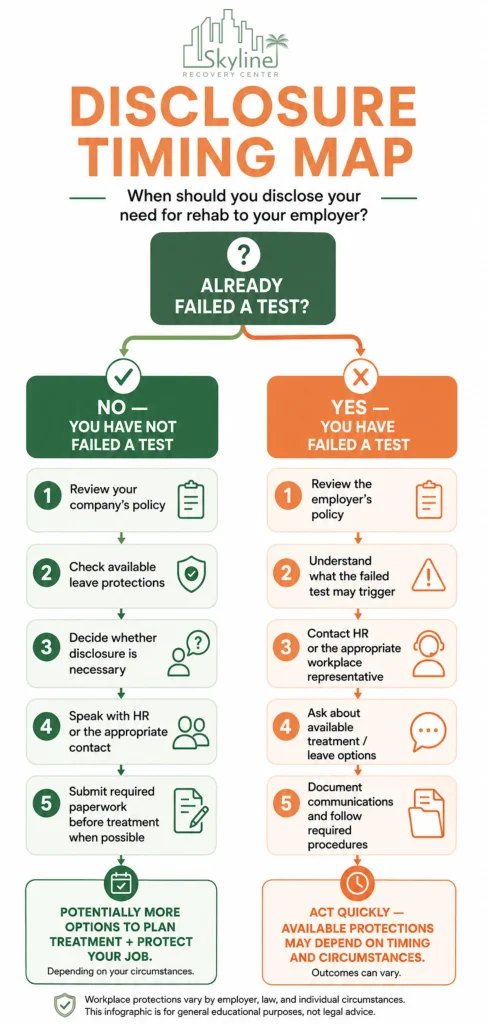
Needing to tell your employer about your rehab does not have a straightforward answer. It varies from company to company and depends on your company’s specific policy. This may be provided to you at the time of your joining, or you may also have it on the website. Additionally, you can speak to the Human Resources (HR) department regarding this.
How to Tell Your Employer You Are Going to Rehab? (With Scripts)
While not all companies require you to inform your employer that you are going to rehab, some do. So, if you are preparing to tell your employer you are going to rehab, here are some steps you can take:
- Schedule a meeting formally. Take out a specific date and time to have this conversation, as it cannot be done in passing or casually. Do this in advance so that you and your organization can prepare for handing off your responsibilities and other tasks until you come back.
- Begin by telling your employer or manager how much your job means to you, and how crucial your well-being is to your productivity and performance.
- Inform them that you have a serious medical condition that requires treatment. Depending on your relationship with your employer or manager and your comfort level, you can choose to disclose how much you wish to. You do not have to mention your mental health or substance use diagnosis if you do not want to. But remember that some companies may need medical certification to verify that you have a serious medical condition that requires treatment.
- Keep the conversation simple and straightforward. You can be polite, but you do not have to overexplain or apologize.
- Focus on returning to your job and committing to your role in the company. Underline the importance of your performance to you and how you are looking forward to returning to your duties and performing to your full ability.
Here are some ways you can have this conversation with your employer or manager.
Simple and Concise (Does Not Require Detail):
“I need to take a medical leave starting from [mention the date] to address a health issue. I will produce the documentation from my doctor. Can we talk about how to navigate the leave and my duties before I leave?”
If You Wish to Be More Direct:
“I wanted to let you know I am entering treatment for my medical condition, starting from [mention the date]. I will be needing some time off for [mention the expected timeline]. I want to handle this responsibly, so I would like to speak about how to navigate the leave and my duties before I begin the program.”
E-Mail (If This Is Your Preferred Mode of Communication):
Subject: Upcoming Medical Leave
Hello [Your employer’s or manager’s name],
I am writing to let you know I shall need to take medical leave starting from [mention the date] for approximately [mention the expected timeline] to enter a treatment program. I am committed to making this process as smooth as possible, so I shall [mention your commitments] before I go.
I would appreciate keeping the details of my treatment private, but I am happy to answer any questions about my duties and responsibilities before I go.
Thank You,
[Mention your name].
What Do You Need to Know If You Are Taking Time Off for Rehab?
The Family and Medical Leave Act (FMLA) allows an eligible employee to take up to 12 weeks off during a 12-month period for rehab and other serious health conditions. To be eligible, you need to fulfill certain requirements, such as:
- You must have worked for your employer for at least 1,250 hours over a 12-month period.
- Your workplace needs to have 50 or more employees within 75 miles.
- FMLA applies to chronic and serious health conditions, including mental health and substance use concerns.
Can You Get Fired for Taking Time Off for Rehab?
You cannot get fired for just taking time off for rehab. This is why it is crucial to know the legal protections that you have. The Americans with Disabilities Act (ADA) and the Family and Medical Leave Act (FMLA) prevent discrimination and allow you to take time off for rehab, so your employer cannot fire you without facing legal ramifications.
However, if an employee’s performance has slipped or is not satisfactory, the employer can fire them.
How Can You Receive the Care You Need and Deserve While Maintaining Your Career?
Seeking the care you need and deserve does not always mean putting your life on hold. While residential and inpatient rehab options may be required for serious cases where safety and stability risks are involved, many with mental health and co-occurring substance use concerns can benefit from structured yet flexible outpatient options as well.
Skyline Recovery Center provides in-person and virtual intensive outpatient program (IOP) options that run for 9-15 hours per week, allowing you the flexibility to maintain your job and focus on your recovery. They can fit around your schedule so that you do not have to compromise on your work.
For more serious needs, partial hospitalization programs (PHPs) are also available, which offer full-day programming. They allow you to go home after your treatment and maintain some parts of your daily schedule.
Taking the Next Step
Taking the next step in your recovery from mental health or substance use concerns is huge. However, you do not need to have everything figured out from the beginning.
Reach out to Skyline Recovery’s licensed and experienced clinicians who will sit with you and understand your history, needs, and goals to recommend the right level of care and a personalized treatment program for you. You do not have to commit to anything right away. This is just to provide clarity so that you can take the next step with greater confidence.
Sources
https://www.dol.gov/agencies/whd/fmla