

Leaving treatment early can feel like the fastest way out of an uncomfortable situation. Maybe the program is not what you expected. Maybe you are struggling with withdrawal, family responsibilities, work, transportation, or the rules. Or maybe you simply believe you can manage recovery on your own.
When treatment is voluntary, leaving may primarily be a treatment decision.
When treatment is part of a court order, probation condition, diversion program, or specialized court program, leaving can create legal consequences as well as treatment consequences.
The important point is that there is no universal California rule saying that a warrant automatically appears a certain number of hours after someone walks out.
What happens depends on your court order, probation terms, treatment program, county procedures, and what your attorney or probation officer does after learning that you left.
If you have already left, the best response is usually not to disappear further. Find out what has been reported, contact your attorney, and ask whether returning to treatment or transferring to another level of care is possible.
The First 24 Hours: What May Happen After You Leave

The first thing that may happen is administrative rather than criminal.
The treatment facility may document that you left before completing treatment.
Depending on the circumstances, the facility may classify the departure as an administrative discharge, discharge against medical advice, or another type of discharge under its policies.
If treatment was court-ordered, the provider may also have obligations to communicate treatment participation or non-compliance to the appropriate party.
The first 24 hours can matter practically because the provider may document your departure and begin any program-specific reporting process, but California does not impose one universal 24-hour deadline for every court-ordered treatment case.
You should not assume that leaving automatically means you have committed a new crime. However, you also should not assume that nothing will happen.
Your court order may require you to:
- Complete a specified treatment program
- Remain in treatment for a particular period
- Follow probation conditions
- Submit to testing
- Report to probation
- Complete an assessment or aftercare
- Follow treatment recommendations
If you leave before satisfying those conditions, your attorney needs to know.
What If You Left Because Treatment Was Not Working?
There is an important difference between abandoning treatment and recognizing that the current treatment setting is inappropriate.
For example, perhaps you entered residential treatment but your clinical needs have changed. Maybe you need a different level of care, more medical support, or treatment for a co-occurring mental health condition.
In that situation, the answer may not be “stay in the same program no matter what.”
It may be a transfer.
Talk to your treatment team and attorney before making another move whenever possible.
If you have already left, contact them immediately and explain why.
Who Files the Non-Compliance Notice?
There is no single California process in which every rehab automatically files the same form with the same person.
The reporting structure depends on the court program and the conditions of your case.
A treatment provider may document your departure and communicate treatment status to the appropriate supervising agency. Probation may then determine whether the departure constitutes non-compliance with a probation condition.
A non-compliance notice, progress report, discharge report, or other program-specific communication may be used to report that a participant did not satisfy a treatment requirement. The term does not refer to one standardized statewide California form.
The exact document and procedure vary.
That is why you should not rely on online claims saying, for example, that “the rehab has 24 hours to report you” or “a warrant automatically issues after 72 hours.”
Those are not universal California rules.
Who May Need to Know?
Depending on your case, the relevant parties may include:
- Your treatment provider
- Probation
- Your attorney
- The court
- A specialized treatment-court team
- The Public Defender’s (PD) office if you are represented by the public defender
If you are represented by a private criminal defense attorney, contact that attorney.
If you have a public defender, contact the appropriate PD office or your assigned attorney.
Your attorney can determine what has actually happened rather than having you guess based on what someone told you.
Bench Warrants, Remand, and Violation Hearing
One of the most common questions after leaving court ordered rehab is:
“How fast will I get a warrant?”
There is no universal answer.
A bench warrant may be issued by a court in response to circumstances such as failing to appear or violating applicable court requirements, but the timing and procedure depend on the case and court.
Leaving treatment does not mean a warrant necessarily appears immediately.
The court may first receive information about the non-compliance, and the response can depend on the terms of your probation or treatment program.
Possible consequences can include:
- A request to return to treatment
- Increased supervision
- A court hearing
- A probation violation allegation
- Additional treatment requirements
- Modification of probation
- A warrant in circumstances where the court determines one is appropriate
- Other sanctions permitted by the applicable law and order
What Is a Probation Violation Hearing?
A probation violation hearing is a proceeding in which the court addresses an alleged violation of probation.
The exact procedures and possible consequences depend on the circumstances of your case.
If you receive notice of a hearing, do not ignore it.
Contact your attorney as soon as possible.
If you are represented by a public defender, contact your PD office or assigned attorney. If you have private counsel, contact your attorney directly.
What About Remand?
Remand generally refers to being taken into custody or ordered into custody rather than remaining out of custody while the case proceeds.
Whether someone is remanded after leaving treatment depends on the specific legal circumstances.
Do not assume that every person who leaves a court-ordered program will automatically be taken into custody.
Likewise, do not assume that leaving means there will be no custody consequences.
Your attorney is the appropriate person to evaluate your specific risk.
Administrative Discharge vs AMA vs Transfer
Not every early departure means the same thing.
Understanding the terminology can help you communicate with your treatment provider and attorney.
Administrative Discharge
An administrative discharge generally means the treatment program ends a person’s participation under its policies.
Reasons can vary.
A person might be discharged because of repeated rule violations, nonattendance, leaving the facility, behavioral concerns, or other circumstances defined by the program.
An administrative discharge is a treatment-program action. It does not by itself determine the legal outcome of your court case.
The court and probation system may treat the discharge as evidence of non-compliance if treatment was a court requirement.
Against Medical Advice
Against medical advice, often abbreviated AMA, generally describes leaving treatment despite a provider recommending continued care.
The phrase itself does not automatically determine whether someone violated a court order.
If treatment is court-ordered, the legal issue is whether your departure caused you to fail a specific court or probation requirement.
Transfer
A transfer can be very different from simply leaving.
If your current program is not appropriate, you may be able to move to another provider or level of care while maintaining compliance.
For example, a person might need a higher level of clinical support, or might no longer require residential treatment and need a structured outpatient program instead.
But do not arrange the transfer privately and assume the court will accept it.
Confirm the change with the relevant treatment and legal authorities.
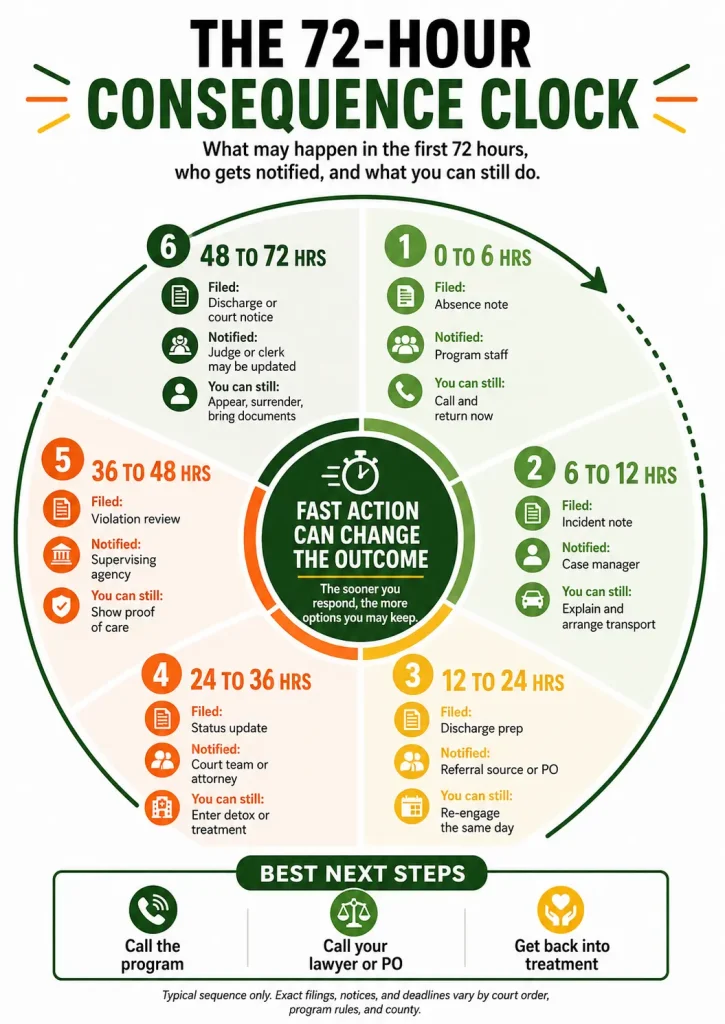
Two Windows Where You May Still Be Able to Address It
If you have already left treatment, there may be two important opportunities to address the situation before the legal consequences become more difficult to manage.
Window One: Immediately After Leaving
The first opportunity is before the situation becomes more complicated.
Contact your attorney.
Contact your treatment provider.
Ask what was documented.
Ask whether you can return.
Ask whether a transfer is possible.
Ask whether probation has been notified.
Do not wait because you are embarrassed.
If you left because of a legitimate problem—medical needs, safety concerns, family circumstances, transportation, or an inappropriate treatment setting—explain what happened.
Documentation may matter.
If you are trying to return to treatment, do it through the appropriate channels rather than simply showing up somewhere else and hoping it satisfies your order.
You can also review the admissions process if you need help understanding the next treatment step.
Window Two: Before the Court Takes Further Action
The second opportunity is before a potential violation becomes more difficult to address.
Your attorney may be able to determine whether a motion to modify probation is appropriate in your circumstances.
A modification can sometimes be relevant when the existing treatment condition no longer fits the person’s clinical needs or circumstances.
However, this is a legal decision.
You should not file or request a modification based on a generic internet template without discussing your case with counsel.
The important thing is to communicate early.
Silence generally does not make a court-related treatment problem easier to resolve.
Wrong Program: Ask for a Level Change
Sometimes the problem is not that you need less treatment.
You may need different treatment.
A person entering residential care may discover that the program does not address their clinical needs. Another person may initially require residential treatment but later be appropriate for intensive outpatient care.
What people sometimes call an ASAM transfer is generally a clinical level-of-care change based on reassessment using ASAM criteria. It can involve moving to a higher or lower level of substance use disorder treatment when clinically appropriate.
The appropriate level of care should be determined through a professional assessment rather than simply choosing the least restrictive option.
If you believe your current program is wrong for you, tell your counselor or treatment team.
Ask whether an assessment can be completed.
Then ask your attorney whether a change in treatment level can satisfy the court’s requirements. Even when the change is clinically appropriate, it does not automatically modify a court order or probation condition; the relevant legal or supervising authority may still need to approve or address the change.
What If Alcohol Is the Main Problem?
If your court requirement involves alcohol, leaving a program does not necessarily mean you should stop treatment altogether.
For someone dealing with alcohol use disorder, a different level of care may be more appropriate depending on the person’s clinical needs.
You can learn more about alcohol addiction treatment and discuss treatment options with a qualified provider.
If the court specifically ordered DUI rehab, make sure any proposed treatment change satisfies the requirements of your particular case.
Do not assume that another program automatically counts simply because it provides substance use treatment.
What If You Are in Drug Court?