
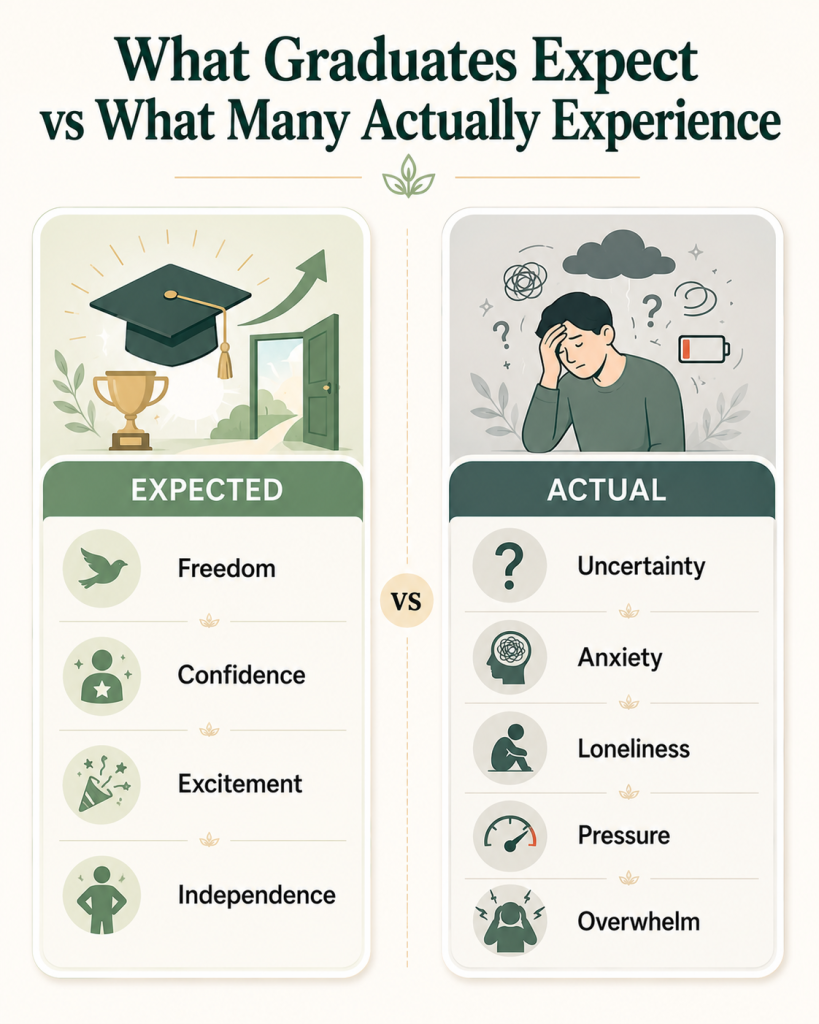
Graduation can feel like one of your life’s biggest achievements – as if everything has led up to this moment. But it is also a transitional period. You have worked hard for years, checked off a major goal, and everyone around you is happy and celebrating. But once the celebrations are over – you are left with anticipation and uncertainty. What will come next – the classes, friends, known routines – they are no longer there. You are stepping into the outside world – “adulting” – and you have to figure everything out immediately.
This is where many recent graduates struggle. The stress and demands to land the perfect job, stable life, and settle down. This can feel heavy and fill you with anxiety after college graduation as to what comes next.
Why So Many Graduates Feel Lost After College?
Until graduation, your life has followed a certain structure. First, there is school, in which you probably had no much choice – your parents or caregivers selected one for you. Then there is college or university where you follow a strict schedule – attend classes, study, research, give exams, participate in co-curricular activities, etc.
However, once this predictable structure is gone, you are left wondering what you are going to do next. Land a job, explore other options, where to live, where to build a life, how to become financially stable, etc. These are all questions that cannot be answered within a week.
This is why many graduates feel lost after college. The familiarity, friendliness, and the kind of protection and optimism that come with college life are gone. What is left now is the outside world – waiting for you. Suddenly, you’re responsible for creating your own structure, making important decisions, and defining what comes next.
Why Anxiety Can Increase After Graduation?
Anxiety after college graduation is common, as it is one of the major life transitions that brings uncertainty, strain, demands, life-changing decisions, and changing relationships. These changes can lead to emotional fatigue and exhaustion, leaving you feeling overwhelmed day after day.
In fact, even the Centers for Disease Control and Prevention’s (CDC) young adult mental health records show that anxiety and depression are some of the most prevalent mental health concerns among young adults.
For some people, the adjustment period is temporary. For others, ongoing stress can begin to impact mental health, relationships, and daily functioning.
Even peer-reviewed analyses published in reputable journals have shown that chronic environmental stress is widespread in academics, which is why there is a global trend of life after college anxiety among recently graduated students. This trend has only been going upward since 2005.
What Post-Graduation Anxiety Can Look Like?
Many people experiencing post-graduation anxiety may function outwardly while quietly struggling internally.
Some of the signs of these struggles are –
Physical Signs:
- Sleep disruption
- Fatigue
- Headaches
- Stress-related muscle tension
Mental Signs:
- Overthinking
- Fear of failure
- Uncertainty about the future
- Comparison to peers
- Decision-related fatigue
Emotional Signs:
- Anxiety
- Irritability
- Self-doubt
- Loneliness
- Emotional exhaustion
- Overwhelm
Behavioral Signs:
- Avoidance
- Procrastination
- Overworking
- Isolation
- Withdrawing socially
Many graduates move through this transition without developing significant mental health or substance use concerns. However, for people already managing anxiety, depression, trauma, or ongoing stress, graduation can amplify challenges that were already present.
When Stress Starts Looking for an Outlet
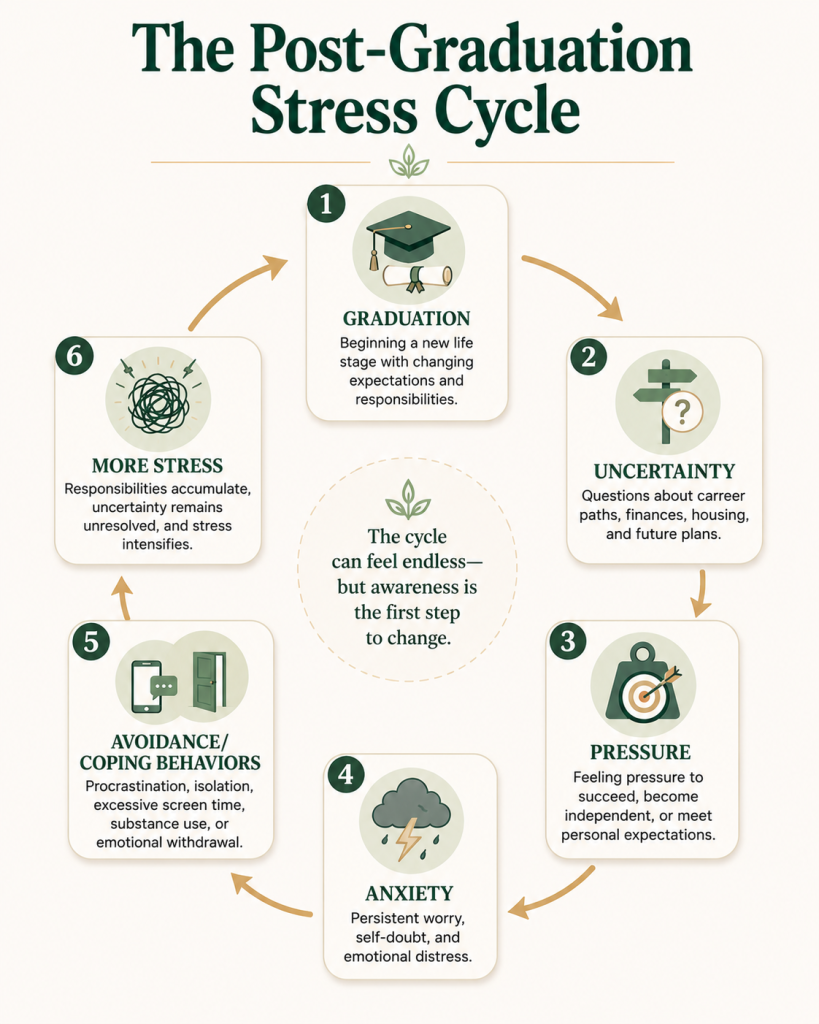
Stress after college graduation is not uncommon. Some stress is good, too, as it motivates you to perform better. However, when stress becomes ongoing and prolonged – it looks for outlets to bury itself into. Unfortunately, these outlets are not productive or fulfilling.
When chronic stress begins to look for an outlet, people begin to use coping mechanisms to handle it. Sometimes, even unhealthy ones, such as substance use.
Stress is one of the most widely known risk factors for substance use disorders and even relapse.
Drinking more after college graduation or reliance on other coping behaviors is common as you try to fill the void left by lost structure and social connections. These habits may offer temporary relief, like temporary arms around your body, but can quietly intensify feelings of overwhelm in the long run.
Why Social Comparison Makes Anxiety Worse?
Many graduates are comparing their behind-the-scenes struggles to someone else’s highlights. This is known as social comparison – a theory developed by Leon Festinger that says we evaluate ourselves in comparison to others when it comes to intelligence, looks, wealth, and success.
This has only become all too common in the digital age of Instagram, TikTok, and the rest. Social media amplifies this by showcasing career milestones, financial wins, relationship highlights, and seemingly perfect timelines.
It is easy to feel left behind when peers appear to have it all figured out while you are still navigating uncertainty. These comparisons can deepen anxiety, drive self-doubt, and make the normal challenges of post-graduation life feel like personal failures.
When Post-Graduation Stress Becomes Harder to Manage Alone
When stress and anxiety are affecting your daily life long after a transition, it may be helpful to learn about the mental health options available to you. Worsening stress, ongoing anxiety, fatigue, sleep disruption, difficulty coping, isolation, declining motivation, and emotional burnout after graduation are signals that the transition may benefit from consistent care and structure.
Learning about your options can help you better understand what level of care is the best fit for you and your needs.
You do not have to be in a crisis or experience a breakdown to reach out. Recognizing the signs of stress and anxiety after graduation early and reaching out early can, in fact, lead to better outcomes.
Support Can Help You Navigate Change
If you are struggling with your life after graduation, tailored care can help you navigate uncertainty, transitions, stress, and other challenges while staying connected with your daily life. This may include therapy, skills training, peer community, or structured outpatient care (especially when weekly therapy is not enough on its own).
These services provide tools to navigate uncertainty, build resilience, understand the identity shifts of young adulthood, and develop healthier ways to manage the pressures of your life after graduation.
You Do Not Have to Figure Everything Out Immediately
The goal is not to have everything figured out at the earliest. The goal is to be kind to yourself to understand that you are going through a period of transition and adjustment.
Speaking with licensed and experienced mental health specialists who will sit with you in safe and confidential settings to understand your story, emotions, experiences, and challenges can be a step forward toward healing and certainty.
You do not have to decide anything right away – just having a simple, non-judgmental conversation where you feel seen and heard can lead you toward a positive change.