

Here is one concern that prevents many from reaching out for the care they need and deserve – “I think I need to go to rehab, but I cannot lose my job.”
This fear can keep you stuck in unhealthy patterns when it really does not have to. The federal law in the U.S. is already built to give you the opportunity to take time off for your rehab without losing your job. However, many may not know that they have this provision or how it functions.
In this article, we shall focus on the Family and Medical Leave Act (FMLA) and rehab – how you can begin, who signs it off, what your employer sees, and whether your workplace is legally allowed to know.
What Is the FMLA?
FMLA stands for the Family and Medical Leave Act. It refers to a U.S. federal law that permits you to take 12 weeks of unpaid leave during a 12-month period for chronic and serious health conditions, such as mental health and substance use concerns.
While it provides 12 weeks of unpaid leave, one of the biggest benefits is that it provides 12 weeks of job-protected leave. This means that when you are eligible for FMLA leave, you can take time off for your rehab and return to your same role after you have completed your rehab and are entitled to the same responsibilities, pay, and other benefits.
Your employer cannot legally fire you for taking your FMLA leave. Therefore, understanding these protections allows many to take the time off for the care they need and deserve.
Who Signs Off the Paperwork for FMLA?
Signing off the paperwork for FMLA is a three-step process. Here is what it will typically look like:
- You will begin this process. If your mental health or substance use needs require taking time off for rehab, then you can notify your employer. You do not have to mention your diagnosis or details you do not want to. You can simply say, “I need medical leave for a serious mental health condition.” But do this in advance – at least 30 days before.
Your employer will then provide the DOL’s WH-380-E certification form within five working days following your request.
- Your healthcare provider or doctor fills out the FMLA form. The medical certification is completed by the licensed clinician who is treating you. They will confirm that a serious health condition exists, the estimated time for the treatment, and whether you need continuous or intermittent leave.
- Your company’s Human Resources (HR) department will sign off on the leave. Once the certification comes back, an HR administrator approves the FMLA request.
What Does Your Employer See?
Many may not be ready to have their employer know their diagnosis or what medical condition they are needing time off for – for judgment or discrimination reasons. It is a valid concern, too.
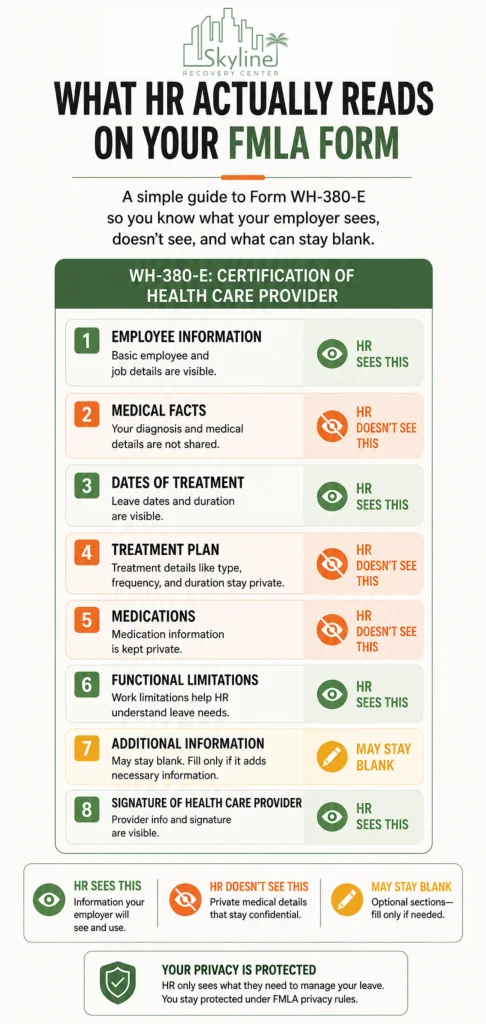
But here is what your employer really sees. They will know that you have a certified serious health condition, the leave dates, and other administrative logistics, like whether you need continuous/intermittent leave, when you will return, etc.
Your employer will not see your diagnosis in detail, treatment or therapy notes, the name of the facility, or anything that is not required for them to administer the leave.
Your mental health or substance use diagnosis and treatment details are protected by the Health Insurance Portability and Accountability Act (HIPAA) and Title 42 of the Code of Federal Regulations, Part 2: Confidentiality of Substance Use Disorder Patient Records (42 CFR Part 2), which means that clinicians or facilities cannot even disclose whether you have taken treatment from them, let alone share your diagnosis or records, without your written consent.
So, your employer or HR cannot ask for more details unless you want them to know.
Who Is Eligible for FMLA?
To be eligible for FMLA, there are a few requirements:
- You have been with your employer for at least 12 months.
- You have worked for at least 1,250 hours during this 12-month period.
- Your employer needs to have 50 or more employees within 75 miles.
If you do not fulfill these requirements, you may still look into the California Family Rights Act (CFRA) in Los Angeles and other regions in California.
What Types of Rehab Does FMLA Cover?
FMLA covers inpatient, residential, and outpatient rehab. Which means you can use FMLA for:
- Medically supervised detoxification (detox)
- Inpatient and residential rehab
- Partial hospitalization programs (PHP)
- Intensive outpatient programs (IOP)
- Follow-up treatment, therapy, and medically necessary appointments that are tied to your recovery.
Can You Get Fired for Taking Time Off for Rehab?
Under the Americans with Disabilities Act (ADA) and FMLA, you cannot get fired for taking time off for mental health or substance use rehab. However, these provisions protect your diagnosis and treatment. They do not protect conduct.
What this means is that if an employee’s performance has slipped or not been satisfactory, the employer still holds the right to let go or terminate an employee.
Taking the Next Step Without Compromising On Your Career
Seeking the care you need and deserve does not always mean putting your life on hold. While inpatient and residential rehab options may be required for serious concerns where safety and stability risks are involved, many can receive structured care through outpatient options such as IOPs and PHPs.
IOPs run for 9-15 hours per week with flexible morning, evening, and virtual sessions that can be fit around your schedule. PHPs offer intensive full-day programming for more serious concerns that do not require hospitalization, but still allow you to return to your home after treatment.
But you do not need to have everything figured out from the beginning. Speaking with licensed and experienced clinicians at the Skyline Recovery Center in safe and confidential settings will give you a clear idea of where you stand and what your next step can be.
Sources
https://www.dol.gov/agencies/whd/fmla
https://ca.db101.org/ca/situations/workandbenefits/rights/program2c.htm