
Have you ever said yes when you actually wanted to say no? Have you ever apologized for things that are not your fault? Have you ever been in a room where you are trying to gauge the mood before you even speak? We have all been there sometimes. But when this becomes a pattern, we may be looking at a fawn response. It can look like politeness on the outside, but beneath it is fear. It is a trauma response – a survival strategy. Understanding what it might be becomes the first step to changing it.
What Is the Fawn Response?
PsychCentral says the fawn response is a pattern of abandoning your own needs in order to avoid conflict or criticism. The fawn response is a direct reaction to threat in which a person tries to stay safe by agreeing or pleasing others.
It was first introduced by Pete Walker, who described it in the context of complex trauma, saying that those who fawn seek safety by connecting their wishes and demands to those of others.
Fawning is not a formal diagnosis. It is used to describe how some adapt to ongoing danger, abuse, neglect, or uncertainty. It typically emerges from childhood experiences and patterns. It is most often linked to complex trauma or complex post-traumatic stress disorder (C-PTSD).
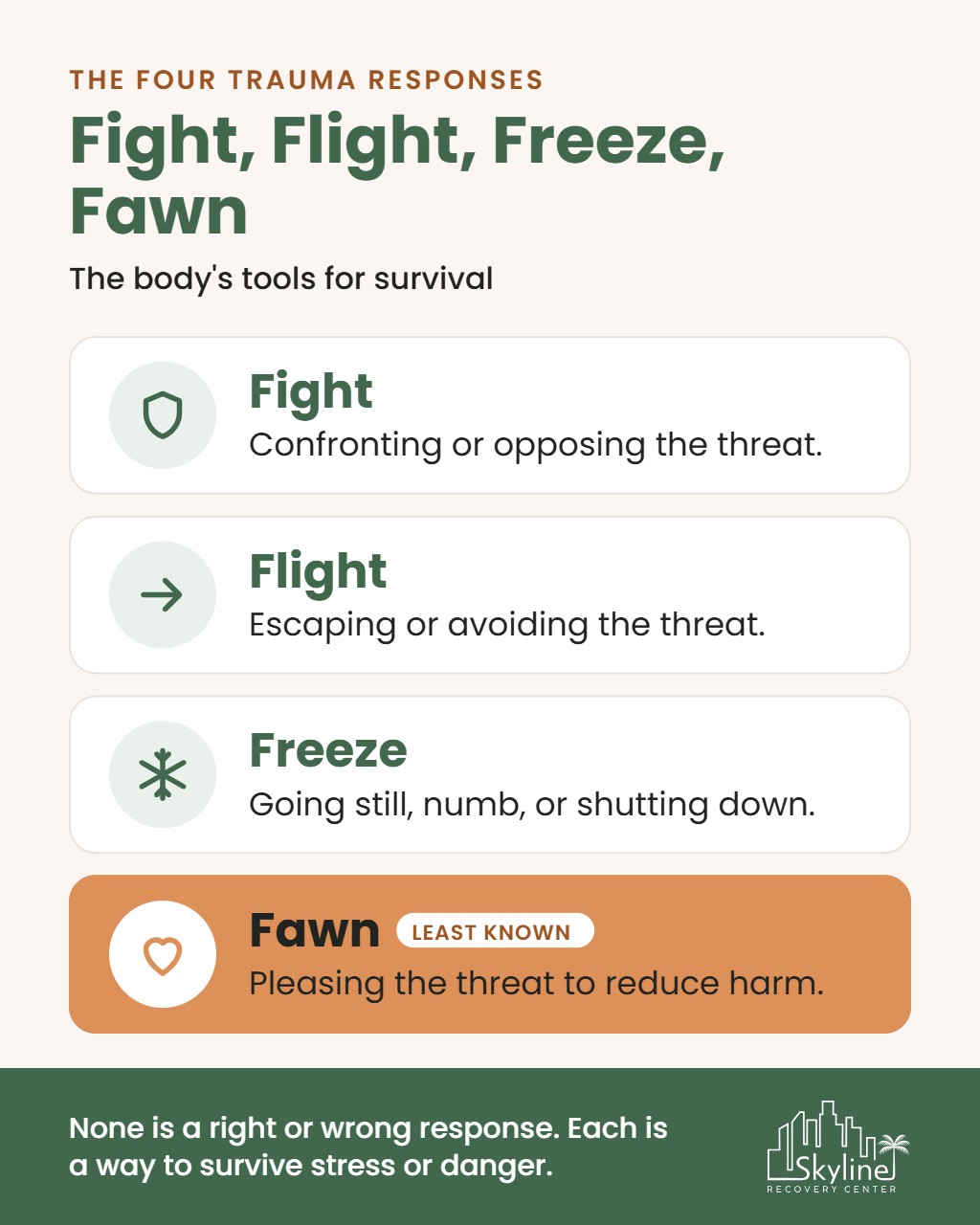
Fight, Flight, Freeze, Fawn: The Four Trauma Responses
We may have heard of the fight-flight-freeze response to stress. Fawn is the fourth, and the one that is not as well known. Here is a brief description of the four trauma responses:
- Fight: Confronting or opposing the threat.
- Flight: Escaping or avoiding the threat.
- Freeze: Going still, numb, or shutting down.
- Fawn: Pleasing the threat to reduce harm.
Neither of these is a right or wrong response in times of stress or danger. They are the body’s tools for survival. Many use more than one, and which one shows up depends on the event and the person involved.
What Are the Signs of a Fawning Trauma Response?
Fawning trauma response can look different for different people, but here are some common signs:
- Agreeing with others even when you disagree
- Struggling to say no or set boundaries
- Apologizing constantly, even when you have done nothing wrong
- Feeling responsible for others’ emotions
- Not knowing what you want, like, or need
- Changing your personality to please whoever you are with
- Staying in unhealthy relationships to keep the peace
- Feeling anxious, resentful, or exhausted after social events and circumstances
- Being drawn to controlling or unpredictable partners
Fawning trauma can also show up physically, as tension, stomach problems, or burnout from constant vigilance. This pattern often overlaps with quiet borderline personality disorder (BPD), high-functioning anxiety, and undiagnosed PTSD, which is why it is easy to mistake for something else.
Why Does the Nervous System Choose Fawning?
The fawn stress response tends to develop when fighting or fleeing is not possible. For instance, a child cannot leave a dangerous home. An adult in an abusive relationship may not be able to safely confront their partner. In those moments, keeping the other person appeased becomes the safest option available.
The brain soon learns that appeasement equals safety and conflict equals danger. After years of practice, the pattern kicks in automatically, even in events or circumstances that are no longer threatening. For instance, a minor disagreement with a coworker can trigger the same threat response that once protected the child at home.
What Is the Difference Between Ordinary Kindness and Fawning?
There are times when we have said yes when we wanted to say no or when we have apologized when we have not been wrong. Sometimes, this is ordinary kindness that we afford to spare feelings. But the difference between what is ordinary kindness and what is fawning in trauma is the motive and the cost.
- Kindness is a choice. Fawning is a learned action that becomes a reflex.
- Kindness comes from a place of concern. Fawning comes from fear of conflict, rejection, or punishment.
- Kindness does not eat away at the person that you are. Fawning erases the real person within.
- Kindness can say no. Fawning feels unable to.
For instance – if you refuse a request, how do you feel? Do you feel slightly guilty, or do you feel fear? Questions like these can help you understand what is going on within.
Does Fawning Overlap With Substance Use?
The fawning response can make the person suppress their needs. This takes a toll over time. The real person with real opinions and desires is never allowed to surface. So, many who engage in the fawn response turn to alcohol or drugs to relax, to calm the anxiety, or to cope with feelings they never allowed themselves to express. Others use substances to feel confident or to numb the resentment that builds up over time.
This is one reason trauma and substance use so often appear together. If you are using substances to manage the stress of fitting into others’ expectations, treating only the substance use leaves the treatment incomplete. Effective dual diagnosis care addresses both with therapy, medication (if needed), skills training, peer community, relapse prevention, and continued care.
How to Stop Fawning, and When It Needs Therapy
Learning how to stop fawning is not just about becoming assertive, but more about teaching your nervous system that it is safe enough to change. Here is how you can begin:
- Begin small. Practice saying no to small requests you do not want to do first.
- Stop before you say yes. Take a breath and ask yourself if you really want to.
- Reconnect with your own preferences. Pick your own meal, music, or plans without checking with anyone.
- Expect discomfort. Anxiety after saying no is normal and fades with practice.
- Set boundaries slowly. You do not need to change every relationship at once.
These are some self-help tips that may help, but therapy is also needed when:
- You cannot say no even when you want to
- You feel numb, anxious, or disconnected from yourself
- Boundary-setting on your own does not lead to much
- You are in or returning to an unsafe relationship
- You are using alcohol or drugs to cope
Trauma-informed therapy is sensitive to your life experiences and works with them, not against them. It allows you to process the experiences that taught you to fawn and builds new ways of feeling safe.